Categories
Religious

When Our Self-Worth Stumbles

“Dear friends, now we are God’s children.”

1 John 3:2 (Common English Bible)

A major challenge faced by most of us is a preoccupation with what other people think of us. Sensitivity to the opinions of our friends and our enemies may sway from one moment to the next. Yet it remains a constant consideration. Politicians are not the only ones who have an ear to the ground or eyes on the polls. The rumblings of popular sentiment about how we are perceived are always on our radar. We crave approval and shrink from disapproval. Our mood for days is often determined by favorable or unfavorable commentary on our character, ability, or accomplishments. We form a mental picture of ourselves through the comments and opinions of those in our orbit. Our self-worth hangs upon what others think of us. The gravitation pull of even the most trifling uncomplimentary remark can result in an emotional collapse.

There may be something of value in paying attention to what others are saying about us. We live in community with one another. We are responsible for one another. Every decision, every behavior impacts the larger community in which we live and work. Most of us want to positively impact our own little portion of the world. We cannot ignore what others may say about us, nor should we. Unfavorable responses that come in our direction may provide insight for a course reset. Negative feedback can be a catalyst for rethinking our approach, our approach to friendships, work colleagues, and family. As we move forward from this day, a constant factor in life is that our yesterday does not have to be our tomorrow. We have the capacity to reflect upon favorable and unfavorable feedback and make a change.

A more fundamental question that we ought to concern ourselves with is what we think of ourselves. That question is answered by our thoughts, habits, and how we deploy our natural talents and gifts in the service of others. We form a mental picture of ourselves through our education, experiences, and fortitude to delve into challenges regardless of the perceived obstacles—real or imagined. Each one of us has limits of knowledge and ability. Yet, with desire and determination, new limits can be put in place of old ones—knowledge and understanding, and ability continually stretched. That is the power and value of attitude. But no one can surpass the limits of one’s current self-image. The mental picture of ourselves either releases energy for continued growth or imprisons us within our present ability.

For people of faith, the Bible helps those whose self-image is stuck for those moments when self-worth stumbles. John, the beloved disciple of our Lord, reminds us that “we are God’s children.” We are unable to fully comprehend God and God’s work in our lives and in the world. We are unable to know “what we will be.” (1 John 3:2b) But John reminds us that the God who created the heavens and the earth, the God who raised Jesus from the dead, claims us as God’s own children. Recalling our glorious nature as God’s own child is enough to strengthen a self-image that is weakened by the judgments of others. There is a deep tendency today to become like what we imagine ourselves to be. The one who claims us ought to matter. Since we are claimed by God, shall we not dare to think well of our value and to live by the highest thoughts?

Joy,
Categories
Religious

Religious Dropouts

“At this, many of his disciples turned away and no longer accompanied him.”

John 6:66 (Common English Bible)

It is now fairly common knowledge that Christian churches across the United States are experiencing decline—a decline in membership, decline in worship attendance, and decline in financial support. Diminishing interest in the church has resulted, in many congregations, a shift from full-time pastoral leadership to part-time, reduced opportunities for spiritual nurture and growth, and a smaller impact on the local community. As congregations grow smaller they are faced with difficult decisions such as merging with other churches or closing their doors permanently. Causes for the decline of the Christian Church across our nation have been studied and solutions have been scarce.

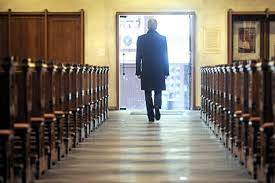
What has received less attention is a phenomenon I will call the “religious dropouts.” These are the people who are regularly present in services of worship, engaged in personal spiritual growth, and participate in the church’s mission to feed the hungry, house the homeless and care for the broken. Vibrant and robust churches are built upon their dedication to Jesus and Jesus’ work through the local congregation. It is not difficult to see that the church is stronger for such people. Then, they simply aren’t present anymore. The place they once occupied in worship is empty. It is a phenomenon that dates back to the earthly ministry of Jesus: “many of his disciples turned away and no longer accompanied him.”

The primary reason for the “religious dropout” remains the same from Jesus’ day until ours: frustration and disappointment. There are present in every faith community people who turn to religion for some things the Christian faith never promised to provide. They expect in religion a kind of magical solution to their problems, anxieties, and illnesses and it hasn’t worked out. Some expect that faithfulness to the church will protect them from job loss, marital discord, and safety from the violence in the world. Others look to the church to shelter their children from everything that is unpleasant and distasteful in the dominant culture. When they fail to receive what they were looking for, they are cool to religion and simply drop out.

After many who followed Jesus turned away, Jesus turned to his disciples and asked, “Do you also want to leave?” It is a good question for each one of us to ask. People who come to our churches expecting only to “get something” or find easy solutions will be frustrated and disappointed. Somehow they have missed that Jesus was betrayed, beaten, and crucified. As William Willimon once commented, why do the followers of Jesus expect to get off any better? What is required is a return to the promise that the faith has always made available: In Jesus Christ, God walks with us through the storms, difficulties, and struggles of life, strengthening us along the way. Life will take us to the depths. When we arrive, Jesus will be there. We are not alone.

Joy,

~ ~ ~ ~ ~ ~ ~ ~ ~ ~

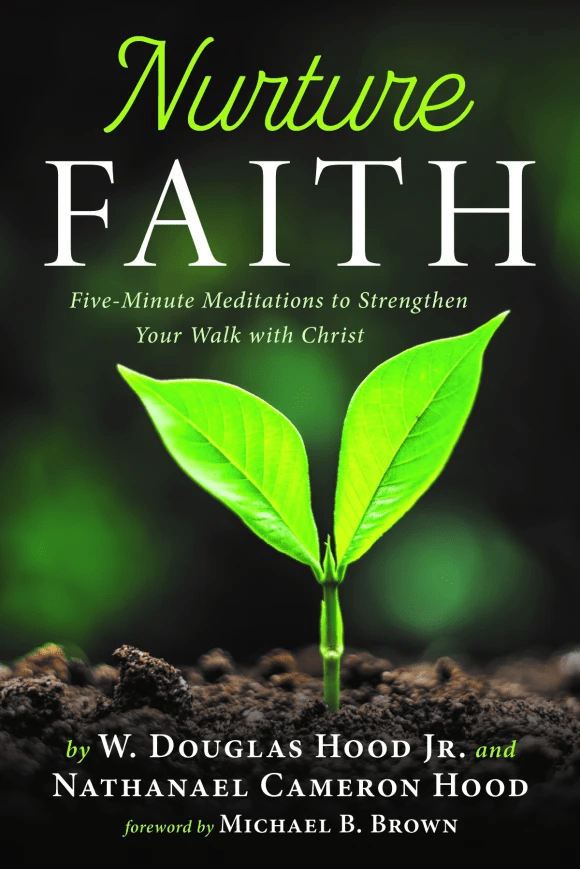
To read more meditations by Dr. Doug Hood and Nathanael Cameron Hood, you can purchase Nurture Faith: Five Minute Meditations to Strengthen Your Walk with Christ from your favorite book seller.

Any royalties received support the ministry and mission of First Presbyterian Church of Delray Beach.

Categories
Religious

The Puzzle of Prayer

We always thank God for all of you when we mention you constantly in our prayers.”

1 Thessalonians 1:2 (Common English Bible)

It is not unusual for someone to ask me, “Please pray for me.” Often my response is an invitation to immediate prayer. My desire is to take the request for prayer seriously. By praying with the person immediately, I wish to say that I care deeply about them and that I appreciate their confidence in the power of prayer. Recently, however, I have begun to question, “Just what do they expect from this prayer?” “Do they really believe my prayer to do any good?”

Naturally, the Bible has much to say about prayer. What is often unrealized is just how frequently the mention of prayer in the Bible is one of complaint. The palmists, the prophets, Job, and the apostle Paul, often questioned the value of prayer, sometimes rather bluntly! Listen to a portion of Psalm 88, “But I cry out to you, Lord! My prayer meets you first thing in the morning! Why do you reject my very being, Lord? Why do you hide your face from me?” (Ps 13, 14) It is clear that today’s church is not the first to question the usefulness of prayer.

It is important—and helpful—to note, however, that in each complaint that is uttered, there is present a fervent belief that something can be expected from prayer. Prayer is never given up on in the Bible, never dismissed as not of any use. What makes each of those who wrestle with prayer people of amazing stature is their absolute confidence in the power of prayer—the power to disrupt at any moment the ordinary with the extraordinary. Without reserve or embarrassment, each character in the Bible shared the same compulsion to pray.

I will freely share that I have no idea how prayer works. The question itself may be foolish simply because it strives to understand God. And someone once wisely declared that if we can ever grasp God, then we must go looking for another God. Any God we can understand with our finite minds is simply too small to save us. What I am confident of is that God was very active in the drama recorded in the Bible and continues to be just as involved in the unfolding drama of life today. And God invites us, repeatedly, to seek the inflowing of God’s grace through regular prayer. Refusal to pray—even when prayer was questioned—simply was not an option for the people of faith in the Bible.

Joy,

~ ~ ~ ~ ~ ~ ~ ~ ~ ~

This mediation is from Dr. Doug Hood’s upcoming book, A Month of Prayer: Five-Minute Meditations for a Deeper Experience of Prayer, featuring prayers by Dr. Leo S. Thorne.