Categories
Religious

God of the Mundane

The following meditation was written by Doug Hood’s son, Nathanael Cameron Hood, a recent graduate of Princeton Theological Seminary.

“While they were eating, Jesus took bread, blessed it, broke it, and gave it to them, and said, ‘Take; this is my body.’ He took a cup, gave thanks, and gave it to them, and they all drank from it. He said to them, ‘This is my blood of the covenant, which is poured out for many.’”

Mark 14:22-24 (Common English Bible)

Something I’ve discovered as I’ve gotten older is that few things make me sound crazier than trying to explain social media trends and memes to people who don’t have or use social media. Therefore, I usually try to avoid mentioning things I see on those sites, but recently I stumbled across a post that stopped me in my tracks like a sudden thunderclap. The post in question was from a young woman explaining how she lost her faith and stopped going to church. Roughly paraphrasing, she wrote that she believed in God as a child because she felt moved by her megachurch’s worship music. However, one day she went to a pop concert, felt the same emotions, and realized it wasn’t God that moved her but live music. As of my writing this article, the post has been viewed and liked over two million times and received over three thousand comments, many from other young people proclaiming similar experiences and disenchantment with organized religion. There was, however, one exception. One of the many comments asked a simple question: “Well, are you sure it wasn’t God you felt at that pop concert?”

Reading this comment, my mind immediately flashed to many of the stories I’d encountered in my church history classes at seminary. Entire wars were fought between different Christian groups and denominations over the “correct” ways to worship and know God. With music, without music. With strict liturgy, without strict liturgy. With lavish decorative artwork, without lavish decorative artwork. My point is that Christians take these things very, very seriously—in many cases, to a dangerous fault. One need scarcely imagine the horror many fellow believers might feel at the idea that you can experience God not in a church but in a concert venue and not with religious hymns but secular pop music.

But is it really that extraordinary to imagine? Time and again in the Bible, we find God deliberately working with the ordinary and the mundane. In Genesis, God uses dust from the ground, not gold or jewels, to form the first human. Many of the miracles in the Hebrew Bible display God’s power not in wealth and physical might but in simple provisions for the poor, needy, and desperate: water from a rock, manna in the desert, and jars of oil in a widow’s house. Jesus himself chose to teach in parables which used common, everyday images familiar to even the poorest of the poor: a farmer sowing seed, a shepherd keeping their sheep, and an attacked traveler. When he wasn’t healing or exorcising demons, Jesus’ miracles seldom strayed far from the table: jars of wine at a wedding, loaves and fish for hungry crowds, nets of fish that threatened to capsize boats.

And then, of course, there is the Last Supper. When Jesus made his everlasting covenant with all humanity on that fateful Passover night, it wasn’t with choice meats and oils, expensive fruits, and imported spices. It was with bread and wine. And with which bread and which wine? The fine, processed white loaves and opulent wines of a king? Almost certainly not. When Jesus broke bread and said, “this is my body,” it was with the tough, grainy loaves of a peasant. When he poured wine and said, “this is my blood,” it was with the watery swill of the poor. Taken together, the Bible doesn’t seem to just approve the search for God in the mundane, it demands it. After all, a God that can only be felt and known in a church is no God at all. Ours is a God who can be found in all facets of creation from the stars in the sky to smell of fresh bread in an oven. And, yes, ours is a God who can be found even at pop concerts.

Joy,


To read more meditations by Dr. Doug Hood and Nathanael Cameron Hood, you can purchase Nurture Faith: Five Minute Meditations to Strengthen Your Walk with Christ from your favorite book seller.
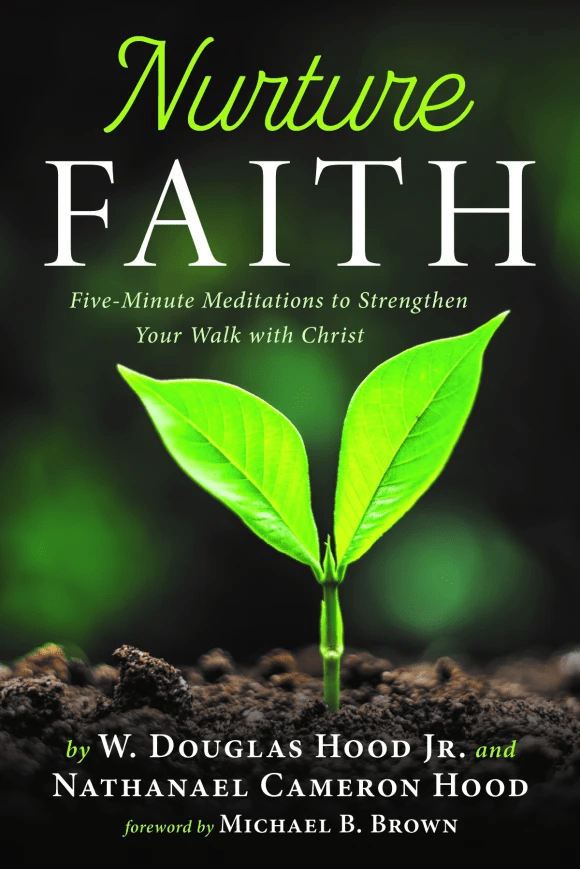
Any royalties received support the ministry and mission of First Presbyterian Church of Delray Beach.

Categories
Religious

Facing the Big Move

The following mediation was written by Doug Hood’s son, Nathanael Cameron Hood, a recent graduate of Princeton Theological Seminary.

They should make me a sanctuary so I can be present among them. You should follow the blueprints that I will show you for the dwelling and for all its equipment.”

Exodus 25: 8, 9 (Common English Bible)

There are few things I dislike more in life than moving. It’s not just that I dislike the boxing and the unboxing, the lifting and the sweating, the stress and the worry—although I very much do. For me, what I dislike the most is saying goodbye to old comforts and habits. Let me explain. During my last year at Princeton Theological Seminary, I lived in a wonderful room on the third floor of Brown Hall, a beautiful recently renovated dorm built in 1865. Located at the heart of the campus, the dorm was a fifteen-second walk from the cafeteria, a thirty-second walk from the main classroom building, and a ten-minute walk from Nassau Street—Princeton’s answer to New York City’s Time Square. I quickly became accustomed to these short walks for their convenience and beauty. In truth, I came to love them.

The room itself was small but large enough to accommodate an overworked student like myself. There, too, I became accustomed to its dimensions and came to love them—I loved how it was exactly seven steps from my bed to my private bathroom and less than one to my large wooden desk. I put an electric kettle for tea on the left side of the desk and sometimes—when deadlines were particularly brutal—a coffee pot on the right. Many were the days (and nights) when I would wrap myself in a blanket, sit in my chair, fire up the kettle and coffee pots, and read, study, and write for hours. Especially when soft rains or snow danced outside my window, my room became an introverted seminarian’s paradise.

But eventually, I had to say goodbye to Princeton, to the short walks I’d loved, the dorm room that became a hideaway, and the desk I’d whiled away so many afternoons and long weekends. I traded them all for an apartment in Brooklyn, where I would be spending the next year of my ministry. The move was stressful, but the hardest part was getting used to my new surroundings. Now, I had no desk, a bathroom down the hall, four roommates, and a twenty-minute walk to my new job. Small complaints, but for an introverted creature of habit like myself, they mattered.

The Book of Exodus also recounts the story of a significant move—the moving of the Hebrew people from Egypt to the Promised Land. Despite having escaped literal slavery, Exodus tells how the Hebrews quickly came to mourn their old habits and surroundings. Remember when we used to have meat and fresh vegetables, they whined. Remember how life was in the old days? There are many stories of God and Moses dealing with these complaints, but one of my favorites is the unusually specific instructions God gives for building the tabernacle, the holy ornaments, and the new priestly duties. Read in a certain light, it’s like God was giving a final response to the Hebrews’ mourning of their old lives with literal instructions for a new one. In time, the Jewish people would look back at this tabernacle as instrumental to their identity as God’s chosen people. The new had replaced the old. They just needed the courage and conviction to trust God and let go of the past. I can relate. Though I miss my old dorm, I’ve come to make my new apartment a home. I have new rituals for how I go about my days and nights, ones that I now dread leaving behind in a future move as much as I dreaded leaving my Princeton ones. And what’s more, I’m comforted knowing that I’m exactly where God needs me to be at this exact moment in my life. What could be better than that?

Joy,


To read more meditations by Dr. Doug Hood and Nathanael Cameron Hood, you can purchase Nurture Faith: Five Minute Meditations to Strengthen Your Walk with Christ from your favorite book seller.

Any royalties received support the ministry and mission of First Presbyterian Church of Delray Beach.

Categories
Religious

Our Greatest Gift to Another

“I made myself holy on their behalf so that they also would be made holy in the truth.”

John 17:19 (Common English Bible)

Jim Rohn writes, “The greatest gift you can give to somebody is your own personal development. I used to say, ‘If you will take care of me, I will take care of you.’ Now I say, ‘I will take care of me for you if you will take care of you for me.’”[i] Rohn seems to have captured wisdom from Jesus’ playbook. In a tribute to his nature and character, Jesus makes the statement, “I made myself holy on their behalf so that they also would be made holy.” Here is Jesus’ secret for maintaining intimacy with twelve irritating men who were his companions. Each disciple pledged their life to the purposes of Jesus. Yet, in one measure or another, they disrupted their fellowship with angry contention as to who came first or who was the most loved. Petty prejudices were evident in their ministry, and they fiercely attacked men who had caught the spirit of Jesus but who did not belong to their select circle.

Abandonment of such a divisive, arrogant, and argumentative bunch of men seems the most reasonable course for Jesus to take. Yes, Jesus loved them. But they also drove him crazy. Certainly, there were stronger candidates that Jesus could trust to care for his divine purposes. But right here, with this statement captured in John’s Gospel, Jesus purposed to lift them, “I made myself holy on their behalf so that they also would be made holy in the truth.” Jesus’ technique is to lift himself closer to God, on the disciples’ behalf, so that as he is changed by God’s presence, he might change the disciples. These foolish, deficient colleagues that Jesus loves are made useful by Jesus’ decision to draw closer to God. As Jesus is changed, the disciples are changed by their proximity to Jesus. There is something intensely practical here for us. Every individual is affected by a relationship they establish with another personality.

Instinctively, we become like those persons we keep company with. This becomes evident in the fashion that dress us, the amusements that entertain us, and the values we embrace. Parents know this. That is why the company their children keep becomes such an important consideration. We spend an hour with a friend, and we come away different. If the experience is less than satisfying, we are conscious of a weakening within our psyche. We question why we entertained unsavory gossip or indulged in humor that inflicts pain upon another. Then we spend an hour with another friend, and we come away with indescribable joy. The world takes on a different complexion than before, and we feel good about ourselves. The world is a beautiful place, more welcoming, more gracious, more inclusive of differences. The dynamic is the same in both cases. We are under a spell of influence.

If we do not have a satisfactory relationship with those who are closest to us, Jesus shows us what we can do about it. We can take care of ourselves—we can lift our own life closer to God until we experience a change in our own character. That change is inevitable. Moses experienced it on the mountain with God. The apostle Paul experienced it on the Road to Damascus. One life rubbing up against another results in change for both. But a life that draws near to God—and remains there for a considerable period—experiences transformation by the divine. If those who are nearest to us seem to disappoint, and seem to have lives marked by the trivial and shallow, we cannot wave aside the blame for such conditions. As Jim Rohn might say, that is the life we inspire by who we are. Take responsibility for spiritual growth and watch the change in those who are closest to you. That will be our greatest gift to another.

Joy,


[i] Jim Rohn, The Treasury of Quotes (Dallas, Texas: SUCCESS Enterprises, LLC, 1994-2021), 88.


To read more meditations by Dr. Doug Hood and Nathanael Cameron Hood, you can purchase Nurture Faith: Five Minute Meditations to Strengthen Your Walk with Christ from your favorite book seller.

Any royalties received support the ministry and mission of First Presbyterian Church of Delray Beach.

Categories
Religious

In the Face of Defeat

“When they heard this, everyone in the synagogue was filled with anger. They rose up and ran him out of town.”

Luke 4:28, 29 (Common English Bible)

Defeat is a single, devasting event. We do not experience defeat—a loss or failure that is potentially injurious to our sense of self-worth—without strenuous effort to succeed. Defeat follows intentional activity to advance forward with some worthwhile goal, some accomplishment that attracts notice from others. Yet, it is most important that we accept that defeat is a single event, not one that defines our life. Defeat is inevitable for everyone who lives purposefully. To put it more simply, defeat is nothing more than a single event in the span of a lifetime. Lives lived richly, lived with a strong drive to achieve, and add value to the world we live in often experience multiple defeats. But each defeat is a singular event. And, as has often been said, each defeat moves one closer to success.

The life of Jesus stands as the supreme example of successful living. And yet, if one pays close attention to that life, it is astonishing to find how often Jesus experienced personal defeat. Jesus did not walk along easy paths that were free of difficulty or opposition. Again and again, Jesus absorbed into himself the anguish of retreat, saw his most noble efforts crash down into ruins and knocked on the door of opportunity only to have that door remained closed. If the life to which we look to for inspiration, encouragement, and hope had to contend with reversal after reversal, defeat after defeat, perhaps we have reason to conclude that such misfortune is woven into the very fabric of life. Defeat in the pursuit of noble ends is not unusual. Defeat—even if one follows another—is not evidence of a defeated life.

Here, in this teaching from Luke’s Gospel, Jesus is teaching in the synagogue. I have sat through the teaching of many wise professors. The response of the students follows along a continuum of disinterest to applause. But not once have I observed anger as Jesus does here in Luke. Not just an expression of rage, Jesus’ students attempt to throw him off a cliff! My study Bible has placed this passage of scripture after the heading, The Rejection of Jesus at Nazareth. Jesus, the most successful life in history, receives rejection, anger, and an attempt on his life. At the end of the day, I imagine that this experience would not be placed on a resume. How did our Lord cope with this failure? Luke tells us that he escaped, went on his way, and resumed teaching. Obviously, a step in the successful treatment of defeat is to simply accept it.

It is not freedom from defeat that characterizes us. Jesus experienced defeat again and again. But rather than be classified as a loser, Jesus accepted defeat and moved on with the single purpose of his life. Undoubtedly, each defeat brought with it a sting of disappointment and discomfort. And most people probably take immediate steps to ensure that defeat is never repeated—at least not in the same fashion. Like a child that experiences pain from some activity, we learn not to repeat the same activity. Unfortunately, defeat is unavoidable for anyone who strives forward. It was unavoidable for Jesus. But Jesus’ behavior amid defeat demonstrates that defeat is not all loss. If we have the same purpose of mind as Jesus, failure and defeat cannot break us. We need only to look at Jesus.

Joy,


To read more meditations by Dr. Doug Hood and Nathanael Cameron Hood, you can purchase Nurture Faith: Five Minute Meditations to Strengthen Your Walk with Christ from your favorite book seller.

Any royalties received support the ministry and mission of First Presbyterian Church of Delray Beach.