“My whole being waits for my Lord—more than the night watch waits for morning; yes, more than the night watch waits for the morning!”
Psalm 130:6 (Common English Bible)
I have always heard that life is the great teacher. Now that I am in my sixties, the truth of that axiom presses more clearly than ever before. But I have found increasingly that young children are also a great teacher. Recently I watched a young child, accidently separated from his mother, experience panic when he realized mom was no longer in sight. They were in a major department store and, apparently, one or the other turned a corner and the other did not. It is a familiar story. I kept my eye on the child while he sought his mother—my desire that he not encounter trouble until mother was again in sight. What I observed of the child taught me a powerful biblical principal—though the child was separated, for a time, from his mother, and though he was clearly experiencing distress from this separation, he continued his search, calling out to her. Here was a child who is dependent upon his mother, now separated from her, who never gave up hope that he would again be with her.
That is the same basic drive located here in this teaching from Psalm 130. The palmist, the protagonist of this narrative, feels separated from God. Present is fear, distress, and disillusionment from the separation. Almost everyone comes to this place, a place when God seems absent, and all hope appears gone. Early on, we try to throw ourselves into our work seeking to ignore the anxiety that grows upon us. But that only helps for a while. Eventually, the darkness of grief, heartache, and disappointment overwhelms. Darkness will not be ignored. We consider one option and then another, any option that might be available to ease the persistent turmoil that stirs deep in our soul. But options are hard to see in the dark, hard to see clearly any way. Eventually we come to realize that we cannot find our way out from the darkness. All that remains is that we wait. We wait for the night to scatter with the rising of the morning sun. That is hard work—waiting. It is realizing there is nothing more that we can do.
Occasionally everyone comes to a place in life when continuing forward seems futile and, overwhelmed by the darkness, considers quitting and surrendering to the night. Events and situations appear to be without hope. The road of despair seems to have no clear destination in sight. But notice what is the same between the lost child in a department store and the psalmist here—both appear to have a small, inextinguishable flame of hope. They both keep going. Giving up and giving in to the darkness is not an option. Perhaps they each experience what seems to be overwhelming forces, or circumstance, that demand surrender. Yet, each one continues to put on foot in front of the other. The psalmist waits for God as the night watch waits for the morning. The lost child turns one corner and then another, calling out to his mother. They both realize that if they keep going, keep hoping, what seems like the end will, eventually, be nothing more than a unpleasant stretch along the longer journey of life.
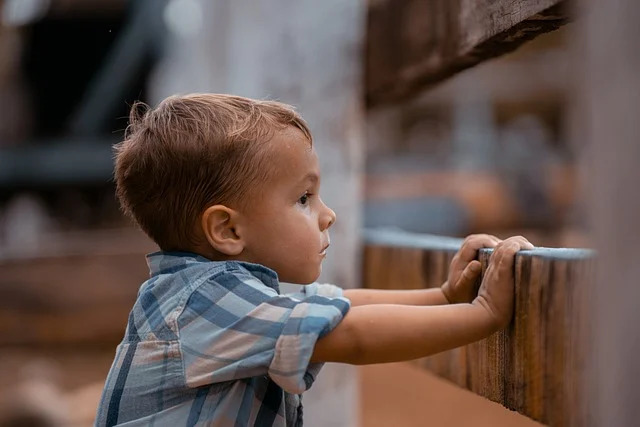
I never learned the thoughts of the child looking for his mother. There was no way of knowing how he was processing this unfortunate separation. I suppose that his continued seeking, his continued calling to his mother, is enough. But the psalmist does give us more. A final word of the psalm is an expression of absolute trust in the Lord, “Israel, wait for the Lord! Because faithful love is with the Lord; because great redemption is with our God!” (verse 7) The cry that began the psalmist prayer is transformed into hope, a confidence that the very nature of God is one that is trustworthy. Faithful love is love that keeps on loving, no matter what. When we are exhausted from the heavy weight of difficulty, crushed from the disappointment of life, and discouraged that we can see no destination, what this psalm teaches is that waiting is the most hopeful thing we can do. Waiting is hard work. But that is why the church has been given this psalm—to encourage us to remain on the job of waiting. For only God brings the morning. And in the light of morning, we find our way back home to God.
Joy,
 Nurture Faith with Dr. Doug Hood