Categories
Religious

More than Conquerors

The following meditation was written by Dr. Yvonne Martinez Thorne for Dr. Doug Hood’s upcoming book, A Month of Prayer & Gratitude: Five-Minute Meditations for a Deeper Experience of Gratitude.

“No, in all these things we are more than conquerors through him who loved us.” Romans 8:37 (NRSV)

“Dr. Martinez, give me hope. We need hope.” These heart-piercing words were uttered by one of my patients in a state psychiatric hospital where I worked as a budding psychologist. I had just finished a psychoeducational session with a group of patients when these words filled that room. As those words lingered in the silence and heaviness in the room, they began to stir something within me. What more was he asking for that I had not provided in the group session? Here was my patient, who usually remained silent, planning his next escape from the hospital, daring to speak these words to others and himself.

I had given him and others in the group what I had perceived as the needed information about substance abuse and mental illness. Yet, his question revealed that what I had presented did not address a deeper need coming from his searching and desperate heart: a deep need for hope. As I wrestled with his request and ensuing questions, I reflected on my own training to give hope and people’s need for hope.

At the beginning of my brother’s life-threatening illness, my family rallied around him, surrounding him with love and hope. Although we had never experienced terminal illness in our family, we were committed to walking alongside our dear brother, no matter the cost. We showered him with loving thoughts, inspiration, and emotional and physical support. As time passed and as the disease progressed in his body, we all found it difficult to sustain hope, his and ours. One day during a visit, he angrily cried out to me: “Don’t put me in the ground. I am not dead yet!” His words registered in my heart that he was reaching out for hope. His words pierced my soul much like my patient’s words did for me that day some months later.

My brother needed hope from his family to continue his journey in hope and in faith, even though we all knew that his life was coming to an end. Truth be told, in these two most challenging years, my family and I became more keenly aware of the power of God’s amazing grace, God’s unconditional love, and God’s abiding presence with us even in end-of-life situations. We were taught valuable lessons about hope, which gave us all a deeper understanding of gratitude in situations that seem to be without hope and in moments of exquisite pain. Hope can light a path to gratitude, if only we choose to remain open and believe in God’s wise purpose for our lives.

Let me put the matter this way. As my dear brother made his way into his eternal home, my family and I experienced the power of faith, compassion, and love that led to the emotional, relational, and spiritual healing we all needed. We learned that when we love as Christ taught us to love—deeply, selflessly, and sacrificially—we are able to reach into the bottomless depths of our capacity to love. This is a life-enriching gift. My family came to understand the Apostle Paul’s reminder to the Christ followers in Rome during their times of unrelenting persecution: “. . . we are more than conquerors through him who loved us.” (Romans 8:37, NSRV) My brother’s sad end became an experience where we all saw our beloved brother fight for his good death in his home with his loved ones surrounding him. With Christ as our hope, we are more than conquerors as we live this life that, at times, asks of us more than we can bear. And, as we struggle in life, and as we grow in our ability to see God in these difficult times, we are able to discover the amazing and faithful love that God has for us, no matter what! For this, I am truly grateful.

The funny thing is. Teachers have confessed that they often learn from their students. Pastors acknowledge that they learn from their parishioners. Psychologists, too, learn from their clients. Gratitude shows up in some strange and wonderful ways.

Joy,
Categories
Religious

Work in Progress

The following meditation was written by Dr. Greg Rapier for Dr. Doug Hood’s upcoming book, A Month of Prayer & Gratitude: Five-Minute Meditations for a Deeper Experience of Gratitude.

“Jesus told this parable to certain people who had convinced themselves that they were righteous and who looked on everyone else with disgust: ‘Two people went up to the temple to pray. One was a Pharisee and the other a tax collector. The Pharisee stood and prayed about himself with these words, “God, I thank you that I’m not like everyone else—crooks, evildoers, adulterers—or even like this tax collector. I fast twice a week. I give a tenth of everything I receive.” But the tax collector stood at a distance. He wouldn’t even lift his eyes to look toward heaven. Rather, he struck his chest and said, “God, show mercy to me, a sinner.”’”

Luke 18:9-13 (Common English Bible)

The big danger in comparing ourselves to others is that we often, even when we don’t mean to, compare our worst with others’ best. We compare the inner machinations of our hearts, our deep and hidden struggles, against the public-facing version of our peers, the pristine and polished, Instagram-filtered, highly curated, tactfully presented as reality but not really reality versions of people we see online. Or at church. Funny how those can feel the same. I imagine most of us, if we’re honest with ourselves, make these comparisons and wince. We feel less-than, broken, and incomplete.

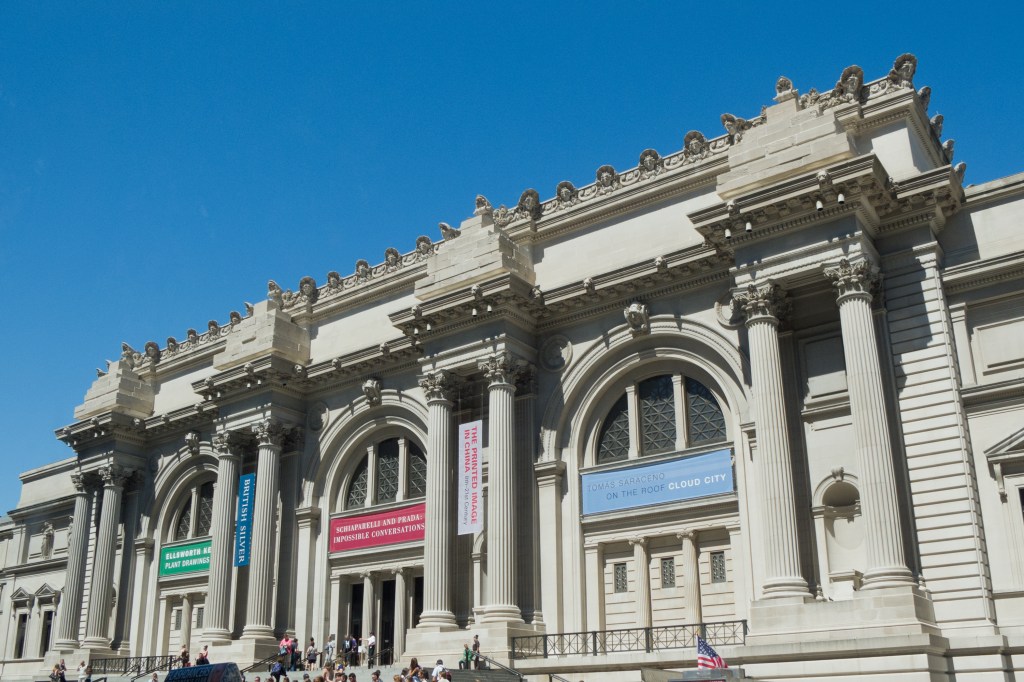
My first time at the Metropolitan Museum of Art in New York, I was absolutely flooded with stimuli—artwork stacked high to the ceiling, people everywhere you look, large tour groups hastily ushered from one room to the next, over two million square feet jam-packed with some of the finest art in the world. In one of the rooms—I couldn’t tell you which because the place was a decadent maze—my friend, a resident New Yorker and de facto tour guide, completely froze. He looked up at a long wall stretched even longer by all the artwork on display. Amongst the ornate, centuries-old, immaculate compositions, one painting stood apart, not because of its perfection, but because of its flaws.

Much of the canvas featured precise, lifelike depictions of saints and angels and Jesus Christ, but in the upper left-hand quadrant, prominently positioned against a blue backdrop, rested two beige mannequin-like figures, sketched out but never completed. Part of the painting was missing. My friend leaned over and whispered, “I like this one because it’s unfinished.”

Jesus’ parable in Luke 18 reminds us that we are all unfinished and that there’s no sense in pretending anything else—not for other people, and certainly not for God. There’s power in humility and dignity in vulnerability. This is how we ought to come before God and pray, not as perfect people, but as works in progress, some quadrants of life more sketched out than others. Because when we do that—when we show up to pray not as our perfect selves but as our whole selves—we discover a God of infinite grace, a God who sees our flaws and loves us anyway, who says this messy, unfinished canvas of a life holds innate beauty and deserves to be displayed. The Scripture reminds us that we’re all God’s people, and that in God’s great gallery, Jesus Christ has reserved a place for us all.

Joy,

Categories
Religious

Standing Up to Life

“I can endure all these things through the power of the one who gives me strength.”

Philippians 4:13 (Common English Bible)

Joan Burns, a friend for over eleven years, recently gave me one of the most honest compliments I have received—“What I enjoy best about our friendship is watching you try to be funny!” That comment demonstrates that Joan is the one—in our relationship—who is genuinely funny. More importantly, the comment demonstrates the strength of our friendship. She doesn’t fear damaging our friendship with her candor. That strength of friendship is what we all seek—and need. It is the strength that defines my relationship with my daughter. I will make a silly comment to Rachael, followed by the self-aggrandizement, “I’m so funny!” Rachael’s simple response is, “No, you’re not!” Naturally, that has become a clever riposte between my daughter and me. Yet, Joan’s quip, “What I enjoy best about our friendship is watching you try to be funny,” has theological depth: Joan acknowledges, in her humor, that I am actually “trying!”

“I can,” begins Paul’s remark to the church in Philippi. The emphasis is not on our dependence upon God. We do not expect God to do everything for us—or we shouldn’t! There are things that we can do and ought to do. There are things we can endure, though they may not be pleasant. A runner understands this. The first mile is unpleasant for every runner, regardless of physical condition. The first mile is a liar. The first mile will plead with us to stop, that this should be a rest day. Or the lie is that we are not strong enough or the weather isn’t ideal for running. Runners are familiar with the lies of the first mile. So, runners endure the lies and continue into the second mile, where the lies are eventually silenced. Our Christian faith calls forth the same endurance. Our faith does not release us from making the best effort within us. We can face difficulties and obstacles that find their way into our lives. It is simply a decision to stand up to life.

But there is more in Paul’s comment to the Philippian Church. The “I can” is matched by strength from God. First comes the resolve that we will stand up to life and make every effort within us to do so. Obstacles, setbacks, and losses will be met with our determination to move through them. That determination will then realize a surge of power that comes from without—the power of the one who gives uncommon strength, the risen Christ. Just as a runner endures the lies of the first mile, the second mile presents new strength for the road ahead. God’s strength always comes alongside our effort, the “I can.” But our own effort comes first. The first mile must be endured. As we approach the end of that first figurative mile of difficulty, a new spiritual confidence emerges that touches every area of one’s manner, disposition, and attitude toward life. The notion of “I can” is not a hope or wishful thinking. It is established upon God’s promise of strength.

The stiffest challenge of life is not questioning God’s presence when we need God. It isn’t asking God to rescue us from difficulty or straighten things out for our family. The stiffest challenge of life is to stop viewing God as a blue genie available to grant our wishes or as a cosmic servant that makes the rough places smooth. God is available to pull us together when we fall into despair and to build upon our own determination to instill courage, strength, and guidance for where we place our next step. God’s desire is that we stand up to life with the confidence that we don’t stand alone. Every success, every accomplishment, every step into the second mile of our life will be through the power of the one who gives strength. Paul’s words here, “I can endure all these things through the power of the one who gives me strength,” renews courage when life becomes difficult. Repeated often, these words will become a vital part of surviving that first mile.

Joy,

Categories
Religious

Beyond the Fence

The following meditation was written by Dr. Greg Rapier for Dr. Doug Hood’s upcoming book, A Month of Prayer & Gratitude: Five-Minute Meditations for a Deeper Experience of Gratitude.

“Jesus did many other things as well. If all of them were recorded, I imagine the world itself wouldn’t have enough room for the scrolls that would be written.”

John 21:25 (Common English Bible)

In elementary school, I had a friend named Clay who bragged that he had the best backyard in the world. He claimed to have two basketball courts, a soccer field, and a playground—all in his backyard. One day, Clay invited me to his house. We walked there after school, and I remember, upon entering, racing toward his backyard.

I rushed outside, looked around, and felt incredibly disappointed. A couple of trees, a barbeque, a football . . . but not much else. The whole yard was smaller than one basketball court—let alone two. Let alone a soccer field. And a playground? Forget about it.

I told Clay his backyard wasn’t big. And it wasn’t special.

Clay calmly picked his football off the grass and chucked it over the fence. Then he began to climb. “Come on,” he said. But I was afraid. I’d never climbed a fence before, and I was scared. Slowly, I began to climb. Just a step or two, enough to peek over the top. And sure enough, next to his football, on the opposite side of the fence, there were two basketball courts, a soccer field, and a playground.

Turns out Clay shared a fence with our elementary school. And that great big backyard that he often spoke of was right there all along.

John 21:25 reminds us that the Bible—for all its value and beauty—is a limited tool and that the verses of Scripture can’t possibly capture the totality of who God is. This verse, the final of John’s gospel, doesn’t seal God’s story shut but rather allows it to unfurl, to open up and bloom like a flower. It reminds us that God is alive and vibrant, even outside of Scripture. It invites us to see past the fences we construct—the fence of church, the fence of Scripture, the fence of scarcity and limited resources—to see past the small-minded lies we tell ourselves about a limited God in a scarce and Godless world, and to imagine a God of abundance. The Scripture calls us to get rid of a boxed-in God and instead, step across the fence into God’s great big backyard, an open space full of wonder, mystery, and abundance, where God’s story is still being written today. And where every new discovery is a reason for gratitude.

Joy,

Categories
Religious

Life’s Undertow

Rev. Dr. Yvonne Martinez Thorne wrote the following meditation to be featured in Dr. Doug Hood’s upcoming book, A Month of Prayer and Gratitude: Five-Minute Meditations for a Deeper Experience of Gratitude.

“But God definitely listened. He heard the sound of my prayer. Bless God! He didn’t reject my prayer; he didn’t withhold his faithful love from me.”

Psalm 66:19, 20 (Common English Bible)

It was the night before my husband and I were to fly back home. We enjoyed our Christmas holidays on the island of Tobago. The sunny days, lush tropical landscapes, the majestic Caribbean Sea, lagoons, tropical birds, and fresh coconut water had done much to restore me from the hustle and bustle of work and ministry. For some unknown reason, I could not fall asleep. After tossing and turning, I quietly got up, went to our patio, and began to pray. I then opened up my Bible. Psalm 66 drew me. I became curious about how verses 11 and 12 might apply to my life: “You brought us into prison and laid burdens on our backs. You let people ride over our heads; we went through fire and water, but you brought us to a place of abundance,” (Psalm 66:11, 12 NIV) I quietly wondered if something was about to happen. Little did I know that I would soon be encountering such a moment.

We took our final swim before heading back to our cabana. The Caribbean Sea was at its best for swimming through the waves and body surfing. My husband and I swam together as we waited for the perfect waves. As we were nearing our time to get out of the water, my husband made a gesture that I interpreted as: “This wave is a beauty. Let’s body surf it.” What I did not know was that this wave was not one to engage. I began to bodysurf the wave when suddenly and immediately, I became caught up in an undertow. What was I to do? Just as I wondered what to do, I heard the word “Surrender.” And I did. The undertow violently tossed me to and fro. I was thrust up into the air perpendicular to the ground by the force of the waves. At one point, another wave slammed my head into the sand. After what seemed like an eternity, the undertow let me go and I wobbly raised myself up and slowly walked to the shore and into the arms of my husband.

As we walked back to the cabana, I remembered the verses I had read. With tears welling up in my eyes, I knew that God had prepared me for what unexpectedly happened. I cried out, and he answered me. He brought me through an undertow and showed me an abundance of his love. I am ever so grateful to him.

As I reflected on what happened that morning, I came away with the thought that God sometimes allows undertows in our lives that we may experience our deep need and dependence on God and on his infinite love for us.

Undertows are powerful ocean currents. They form when receding waters from waves that have previously broken onto the shore merge together with incoming waves. Sometimes in our lives, we can experience the pull of undertows created by situations that come over us like waves breaking against our souls. They overwhelm us. Sometimes, we are able to face them and resolve them. At other times, the waves of life seem to break continuously against us and create an undertow, a powerful current that renders us unable to break free. The divine instruction remains the same: Surrender. “You let people ride over our heads; we went through fire and water, but you brought us to a place of abundance.” (Psalm 66:12 NIV). These moments invite us to a deeper experience of God’s love and goodness. With a surrendered heart, we overflow with gratitude.

Joy,