“After taking the bread and giving thanks, he broke it and gave it to them, saying, ‘This is my body, which is given for you. Do this in remembrance of me.’”
Luke 22:19 (Common English Bible)
Notice here, in this teaching from Luke’s Gospel, Jesus’ habit of thanksgiving. What is significant is Jesus giving thanks over a piece of ordinary bread, “After taking the bread and giving thanks.” This habit of giving thanks over the ordinary strikes some as unusual. Many of us are more accustomed to giving thanks for the extraordinary: a surprised gift of appreciation or an unusual demonstration of kindness. We were taught as children that such occasions merited giving an expression of gratitude. But here, Jesus takes in hand an ordinary piece of bread and, before serving the disciples dinner, gives thanks. Praise abounds in the narratives of Jesus. Any perusal of the four Gospels impresses upon the consciousness that praise is inseparable from the Jesus stories. But thanksgiving? And thanksgiving for the ordinary? That is also present. But noticing Jesus’ habit of thanksgiving requires a more careful reading.
Another discovery that is rewarded to the careful reader of the Gospels is that Jesus is noticed by the disciples, not in moments of praise, but in moments of thanksgiving. After a rather difficult week in Jerusalem that included an arrest of Jesus, the crucifixion of Jesus, and Jesus’ resurrection, two disciples were traveling to Emmaus. Jesus suddenly shows up with them. But the two disciples don’t recognize him. That may draw a question from the reader. The disciples were with Jesus for three years and now fail to recognize him? Our own experience answers that quandy. If we see a familiar face in a context we don’t expect, there may be a moment of recognition, but we brush it aside. That person can’t possibily be traveling in Europe at the same moment that we are! There may be a moment of recognition by the disciples, but it can’t be Jesus. He was crucified. But the moment Jesus takes bread and gives thanks—presto! It’s Jesus.
Perhaps there is wisdom for each of us to pay more attention to Jesus’ use of thanksgiving. Particularly because, in the hands of Jesus, the ordinary becomes extraordinary. When I officiate over a baptism, I stir the water in the baptismal font—ordinary water placed there minutes earlier from an ordinary tap. It is then I pray, “With an unseen hand, touch these waters and separate them from their ordinary use and make them extraordinary. May they become cleansing waters, removing guilt from the one who will be baptized.” When I stand before the Lord’s Table, I pray, “Separate this bread and this cup from their ordinary purpose so that they may become a symbol of your power and love in our lives, reconciling us once again to Jesus.” In thanksgiving, the common becomes radiant with the holiness of God, which, in turn, makes for a transfigured world. It is then a world that has become rather dull is made vivid with wonder.
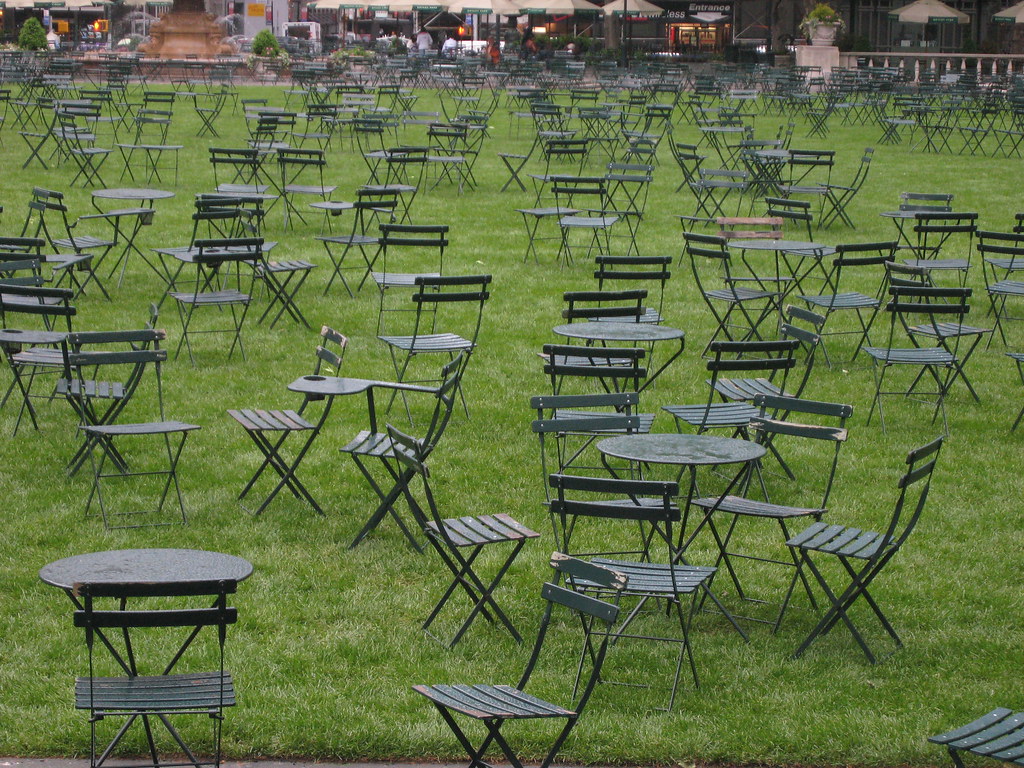
Life is made up of very ordinary things. Thanksgiving for them opens the channels to see God where God has been previously unnoticed. Common places of life become extraordinary, even holy. Bryant Park in New York City is a holy place for me. Where many visitors and residents find a respite, I experience God as a very near presence. Every opportunity I am in that city I take the time to be in Bryant Park for prayer. I pray for my ministry, the congregation I serve, for my family, and for the City of New York. I pray for the welfare of the city. I pray that God will work redemptive wholeness where there is brokenness. When I can’t be in New York, I sit in a Bryant Park chair I have in my office. Seated there, I continue my prayers for the city. Consequently, my soul is filled with the fullness of God. I see God in the city where others may only see commerce, indulgence, and brokenness. Thanksgiving becomes a beautifier that transforms that city for me. There is great wisdom in following the example of our Lord for giving thanks for the ordinary.
Joy,
 Nurture Faith with Dr. Doug Hood