Categories
Religious

A Year of Faith and Hope

“So what are we going to say about these things? If God is for us, who is against us?” Romans 8:31 (Common English Bible)

It is always possible to dwell on the bright as well as the dark side of life. Yet, for many people, they are inclined to direct their attention to what may go wrong, to anticipate the bitter rather than the sweet, the tears rather than the smiles, and the difficulties rather than the opportunities that may lie in the New Year that stretches out before them. This way of looking at things is probably nothing more than a carryover from how their parents approached life from year to year. Perhaps this is a view fashioned by disappointments and struggles over many years. But it remains a choice that anyone can make—quieting the voice of negativity and grasping the promise of faith that God is for us as we cross from one year to the next.

This is not to be blindly idealistic. People of faith know as much about real trouble as any non-believer, perhaps much more, in fact. Those who don’t have faith often need a distraction to push through each day, some measure of artificial stimulation. Having no faith or hope they look to escape from the real challenges that confront every one of us. Alcohol, recreational drugs, or acquiring things of luxury and comfort divert attention from life’s challenges and disappointments. Conversely, people of faith are genuine realists. They acknowledge and face real misfortune and then look right through the trouble to something beyond—they see hope in the promises of their faith. That is the real difference.

It should be clear that the Bible never asks that we turn away from the facts, that we deceive ourselves in order to be a people of faith. As Christians, we are aware of our own capacity for greed, cruelty, and selfishness. We know that those who would trample over us care little about our faith and that disillusionment lurks around every moment of every day. Such has always been the case and always will be. Emerson said: “He has not learned the lesson of life who does not every day surmount a fear.”[1] But, in faith, we can look into the dense fog of the New Year without too much uneasiness because God moves forward alongside us, a God that is always struggling with us, always bringing good out of evil.

Faith stones

Life can be a struggle. Not every cloud will have a silver lining and not every wrong will be righted in this life. Ambitions may continue to remain unfulfilled and broken relationships may never be repaired. But that does not diminish the promise of faith that God is for us. Who believed that every round of disappointment, meanness, and heartbreak is the whole story? Life also consists of laughter, moments of happiness, and serendipitous occasions of surprise and delight. Each struggle to be experienced above the loud clamor of negativity. Our own free agency allows us to choose the tone that we attach to our lives. Perhaps all we need in the New Year is to be reminded that if God is for us, who is against us?

In this New Year, let us not forget, O Lord, that we are more than conquerors in the love, presence, and power of our Lord, Jesus Christ. Amen.


[1] Emerson, Ralph Waldo. The Complete Works of Ralph Waldo Emerson: Society and Solitude, Twelve Chapters, Boston: Houghton, Mifflin & Co., 1904, 276.


Categories
Religious

The Spirit of Christmas

“Glory to God in heaven, and on earth peace among those whom he favors.”

Luke 2:14

There is a Christmas song that ponders in a rather wistful manner, why the world is unable to embrace the spirit of Christmas all year long. At Christmas, we crawl out from our hard shell of self-concern, our eyes sparkle with wonder, and we behave with an uncharacteristic charity toward all people. We slog through eleven months of drudging effort, eyes squarely focused upon survival in a competitive marketplace with little attention to others, and then Christmas comes. We throw off the heavy coat of selfishness for a time. Kindness permeates the places of our souls made callous by fear of scarcity and generosity flows from hidden springs in our hearts. We play, we laugh, and we are amiable to strangers and friends equally. That Christmas song is on to something. Why can’t we have the spirit of Christmas all year long?

Bethlehem is a divine interruption. The world today is a little different from the world that welcomed the birth of Jesus. Enemies are everywhere and national security continues to be a pressing concern. The inequity of wealth among people of every nation conveniently ignores the apostle Paul’s call that those who have much shouldn’t have too much and those who have little shouldn’t have too little (2 Corinthians 8:13–15). But Bethlehem invites the world to a fresh imagination; to imagine a world where instruments of war are repurposed into farming instruments and people impulsively and joyfully share from their abundance so that others may simply have enough. Bethlehem asks that we look at the world differently, and asks that we live differently.

The spirit of Christmas is a deep and persistent call to pay attention to God. It is a call to see and participate in the creation of a new world where peace and goodwill abound. Bethlehem is not an occasional indulgence—an occasion where we lay aside for a moment careful attention to our health and consume copious quantities of Christmas cookies and eggnog. Bethlehem asks that we care about the world of which we are a part. Bethlehem invites us to join the angels in announcing that God has unleashed upon the world a new order where all people may find carefree rest in God. Bethlehem is not a charming dream. It is not an aspirational goal. Bethlehem is a confident and certain reality. God has come into this world and nothing is going to be the same.

Go to Bethlehem this year. Go and bow down before this magnificent birth of a new world order. Discover in Bethlehem God’s divine intention for each of us; discover that peace and goodwill are not for one month of the year but God’s gift to be embraced and shared all year. But if you go to Bethlehem, recognize that Bethlehem makes demands upon all who visit. Bethlehem asks that you dedicate your life to speeding up the tempo of goodwill in all your relationships. Bethlehem will ask you to guard your speech and exercise restraint in the use of acrimony, harsh, and mean criticism. Bethlehem will demand civility, humility, and respect for others, particularly for those you disagree with. And Bethlehem will ask of you uncommon generosity toward others. Bethlehem asks a good deal from all who visit. But Bethlehem gives in return God’s peace. That is the spirit of Christmas.

Joy,

Categories
Religious

Prayer in a Time of Distress

“In tight circumstances, I cried out to the Lord. The Lord answered me with wide-open spaces.”

Psalm 118:5 (Common English Bible)

Early in 2015, I was elected Moderator of the Presbytery of Tropical Florida. For the reader unfamiliar with Presbyterian government, the office I was elected to is the highest elected office for what is like a diocese in the Roman Catholic Church. Minutes before the meeting convened, I nervously paced outside in the parking lot. Nervous because the first item that day before the governing body was divisive. And, I would be responsible for managing the period of discussion and the vote that would follow. Nervous because the Presbytery was facing deep challenges that would require my best leadership and care. Nervous because of the high level of trust that was being placed upon me to lead. I paced alone in the parking lot as clergy and lay leaders gathered inside prepared to elect me as their leader for such a time as this. I looked to God, in prayer, for strength.

Then, a car pulled alongside me and stopped. The driver was Dr. Thomas K. Tewell. He had been staying as a church guest in the church’s guest house during business in South Florida. Formally the Senior Pastor of the Fifth Avenue Presbyterian Church of New York City, Tom was now the Executive Director of Macedonia Ministry—an equipping ministry for pastors. Tom is a church leader I had admired and looked to for guidance for over a decade at that time. Unaware of the Presbytery meeting about to convene indoors, and unaware that I was to be elected as Moderator of the Presbytery, Tom simply stopped to say good morning. I told Tom of the meeting about to convene and my discomfort. He parked his car, got out and gripped my hand and prayed with me. More than my hand was gripped. The contagious energy and faith of an extraordinary man of God lifted me above all distress. 

Tom’s radiant and victorious personality lifted me far above my nervous anxiety and placed me in the certain presence and care of God. My concerns simply disappeared. I experienced a strength that was absent before and a confidence that I was exactly the person to serve the Presbytery at this challenging time. Immediately following my election as Moderator and the gavel of leadership placed in my hand, I addressed the Presbytery with these words, “God is here with us. In our disagreements, let us conduct God’s work with humility, civility, and respect for one another.” Those words, spoken with a conviction that was absent minutes earlier, flowed from the power of Dr. Thomas Tewell’s friendship, mentorship, and love for me. That serendipitous encounter with Tom changed me.

This has been the experience of the greatest saints of the church. In times of personal anxiety and distress, they came before God, in prayer, and sought communion with the divine. They did not necessarily seek something. Though they each recognized prayer for material things as legitimate, they unfailingly relegated such things to a secondary place. Of greatest value was the experience of the transcendent that would purify moments of distress—a power that would lift one above the trivia of life. Such Christian men and women recognized that fellowship with God, in prayer, transformed them from victim to undefeatable. Prayer reminds us that God is the one who upholds all things and that God’s power is patient, loving, just, and holy. This teaching from Psalms reminds us that God takes those squeezed, cramped, and distressed and places them in “wide-open spaces” where they can breathe again.

Joy,

Categories
Religious

Christmas Begins with Wonder

“She gave birth to her firstborn child, a son, wrapped him snugly, and laid him in a manger, because there was no place for them in the guestroom.” Luke 2:7 (Common English Bible)

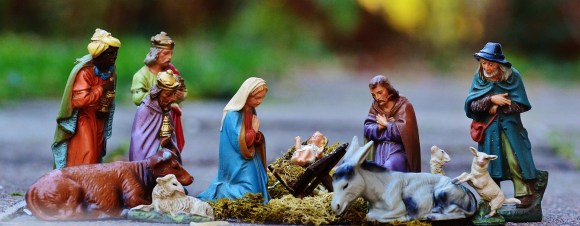
My wife, Grace, and I collect nativity sets. Over the course of our marriage, we have collected over thirty, each beautiful and unique in their own way. Several have come from Congo, Africa, where my wife was born and raised by missionary parents. Others are from Guatemala, Argentina, Peru, Mexico, and Israel. There are also beautiful sets from Alaska and from Native American reservations in the west. Two are whimsical sets from North Carolina—one that depicts every character of the nativity as black bears and another as red cardinals. They have been fashioned from metal, stone, clay, wax, and wood. Each represents a cherished memory and all stir the wonder of that first Christmas.

Christmas begins with wonder. It is a story whereby we are reminded that God has come into the world for every generation and for every person. It is a story that defies reasonableness. God, the creator of the heavens and the earth and all that is them, comes to earth as a vulnerable baby, to parents of little material possessions, in the nondescript town of Bethlehem. The parents have no stature, no power, and no capacity to provide anything more than a manger to place their first child. Absent is any hint of privilege, any suggestion that this family will ever attract the notice of others. Yet, shepherds are drawn to the nativity, leaders of great nations travel considerable distances to bring gifts of substantial value and angels sing from the heavens of the birth of Jesus. The story is astounding, incredible, and outside the parameters of credible story-telling. Serious engagement with the Christmas story begins with wonder.

Wonder is not doubt. For those who doubt, they are unable to see. Their eyes are clouded by a determined focus on what they understand. Wonder exists where there is hope in inexplicable love, and uncommon generosity. Wonder springs from believing that there is more in life than can ever be explained and the deep desire to be surprised. Christian wonder arises from the ancient promise of a God who cares deeply for us, clinging to that promise tenaciously, particularly at those times when there seems to be so little evidence for it, and paying attention, recognizing that God may surprise us at any moment. The shepherds and the magi arrived at the nativity, not because of incontrovertible proof that the Holy Son of God was born but because they were paying attention to a God that surprises.

For Christmas to be more today than a nostalgic glance backward there must be a recovery of wonder. We cannot rejoice at Christmas unless we rejoice that this is a season where images of the nativity—in our homes and churches, on Christmas cards and wrapping paper—remind us that God comes to us in unexpected moments, in a surprising fashion, and always in a manner that is beyond our ability to understand. We live in a world that doesn’t know what to make of the love of God; a love that is free of ulterior motives. God baffles us and mystery and wonder permeate God’s presence and activity in the world, including the Christmas story. The Christian faith has never asked that we dismiss our questions. But its promises are realized only when we permit ourselves to experience expectant wonder once again.

Joy,