Categories
Religious

The Spirit of Christmas

“Glory to God in heaven, and on earth peace among those whom he favors.”

Luke 2:14

There is a Christmas song that ponders in a rather wistful manner, why the world is unable to embrace the spirit of Christmas all year long. At Christmas, we crawl out from our hard shell of self-concern, our eyes sparkle with wonder, and we behave with an uncharacteristic charity toward all people. We slog through eleven months of drudging effort, eyes squarely focused upon survival in a competitive marketplace with little attention to others, and then Christmas comes. We throw off the heavy coat of selfishness for a time. Kindness permeates the places of our souls made callous by fear of scarcity and generosity flows from hidden springs in our hearts. We play, we laugh, and we are amiable to strangers and friends equally. That Christmas song is on to something. Why can’t we have the spirit of Christmas all year long?

Bethlehem is a divine interruption. The world today is a little different from the world that welcomed the birth of Jesus. Enemies are everywhere and national security continues to be a pressing concern. The inequity of wealth among people of every nation conveniently ignores the apostle Paul’s call that those who have much shouldn’t have too much and those who have little shouldn’t have too little (2 Corinthians 8:13–15). But Bethlehem invites the world to a fresh imagination; to imagine a world where instruments of war are repurposed into farming instruments and people impulsively and joyfully share from their abundance so that others may simply have enough. Bethlehem asks that we look at the world differently, and asks that we live differently.

The spirit of Christmas is a deep and persistent call to pay attention to God. It is a call to see and participate in the creation of a new world where peace and goodwill abound. Bethlehem is not an occasional indulgence—an occasion where we lay aside for a moment careful attention to our health and consume copious quantities of Christmas cookies and eggnog. Bethlehem asks that we care about the world of which we are a part. Bethlehem invites us to join the angels in announcing that God has unleashed upon the world a new order where all people may find carefree rest in God. Bethlehem is not a charming dream. It is not an aspirational goal. Bethlehem is a confident and certain reality. God has come into this world and nothing is going to be the same.

Go to Bethlehem this year. Go and bow down before this magnificent birth of a new world order. Discover in Bethlehem God’s divine intention for each of us; discover that peace and goodwill are not for one month of the year but God’s gift to be embraced and shared all year. But if you go to Bethlehem, recognize that Bethlehem makes demands upon all who visit. Bethlehem asks that you dedicate your life to speeding up the tempo of goodwill in all your relationships. Bethlehem will ask you to guard your speech and exercise restraint in the use of acrimony, harsh, and mean criticism. Bethlehem will demand civility, humility, and respect for others, particularly for those you disagree with. And Bethlehem will ask of you uncommon generosity toward others. Bethlehem asks a good deal from all who visit. But Bethlehem gives in return God’s peace. That is the spirit of Christmas.

Joy,
Categories
Religious

Christmas Begins with Wonder

“She gave birth to her firstborn child, a son, wrapped him snugly, and laid him in a manger, because there was no place for them in the guestroom.”

Luke 2:7 (Common English Bible)

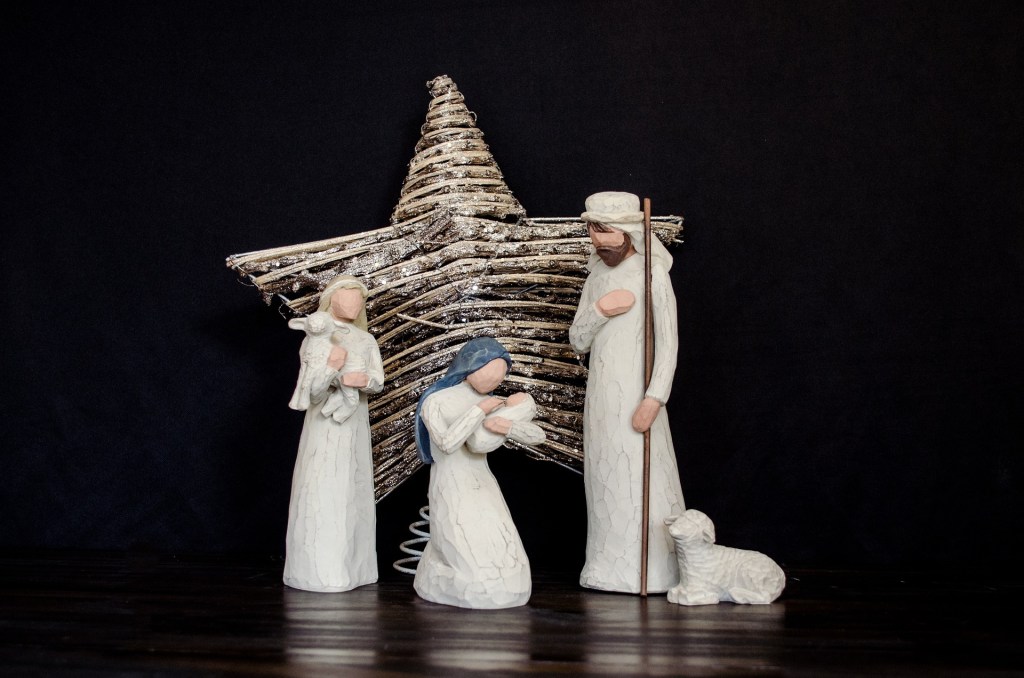
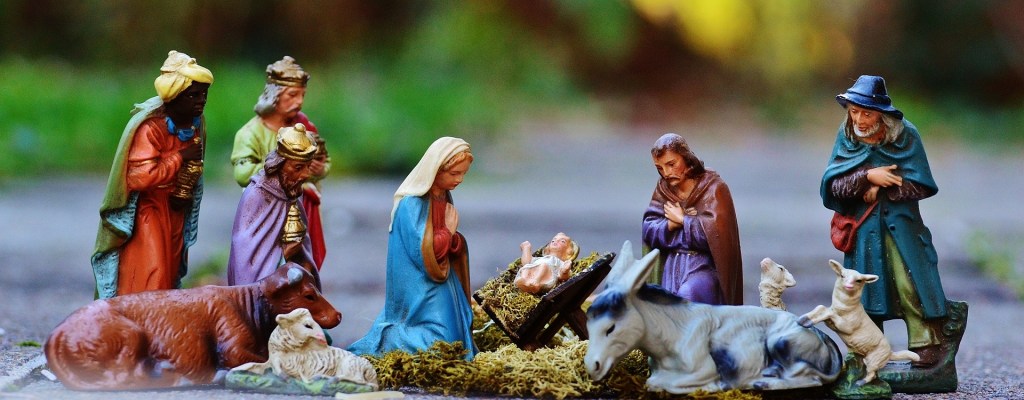
My wife, Grace, and I collect nativity sets. Over the course of our marriage we have collected over thirty, each beautiful and unique in their own way. Several have come from Congo, Africa, where my wife was born and raised by missionary parents. Others are from Guatemala, Argentina, Peru, Mexico and Israel. There are also beautiful sets from Alaska and from Native American reservations in the west. Two are whimsical sets from North Carolina – one that depicts every character of the nativity as black bears and another as red cardinals. They have been fashioned from metal, stone, clay, wax and wood. Each represents a cherished memory and all stir the wonder of that first Christmas.

Christmas begins with wonder. It is a story whereby we are reminded that God has come into the world for every generation and for every person. It is a story that defies reasonableness. God, the creator of the heavens and the earth and all that is them, comes to earth as a vulnerable baby, to parents of little material possessions, in the non-descript town of Bethlehem. The parents have no stature, no power and no capacity to provide anything more than a manger to place their first child. Absent is any hint of privilege, any suggestion that this family will ever attract the notice of others. Yet, shepherds are drawn to the nativity, leaders of great nations travel considerable distances to bring gifts of substantial value and angels sing from the heavens of the birth of Jesus. The story is astounding, incredible, and outside the parameters of credible story-telling. Serious engagement with the Christmas story begins with wonder.

Wonder is not doubt. For those who doubt, they are unable to see. Their eyes are clouded by a determined focus on what they understand. Wonder exists where there is hope in inexplicable love, and uncommon generosity. Wonder springs from believing that there is more in life than can ever be explained and the deep desire to be surprised. Christian wonder arises from the ancient promise of a God who cares deeply for us, clinging to that promise tenaciously, particularly at those times when there seems to be so little evidence for it, and paying attention, recognizing that God may surprise at any moment. The shepherds and the magi arrived at the nativity not because of incontrovertible proof that the Holy Son of God was born but because they were paying attention to a God that surprises.

For Christmas to be more today than a nostalgic glance backward there must be a recovery of wonder. We cannot rejoice at Christmas unless we rejoice that this is a season where images of the nativity – in our homes and churches, on Christmas cards and wrapping paper – remind us that God comes to us in unexpected moments, in a surprising fashion, and always in a manner that is beyond our ability to understand. We live in a world that doesn’t know what to make of the love of God; a love that is free of ulterior motives. God baffles us and mystery and wonder permeate God’s presence and activity in the world, including the Christmas story. The Christian faith has never asked that we dismiss our questions. But its promises are realized only when we permit ourselves to experience expectant wonder once again.

Joy,

Categories
Religious

Praying Without Expectation

“While Peter was held in prison, the church offered earnest prayer to God for him.” Acts 12:5 (Common English Bible)

The great Apostle, Peter, is sleeping in prison, bound in chains. King Herod’s poll numbers are up. Previously, he had James, John’s brother, killed with a sword. This pleased the Jews, so Herod arrested Peter as well. Once a policy decision resonates with the voters, politicians tend to do more of the same. Peter is placed in a prison with sixteen soldiers assigned to guard him. Seems excessive for one man. Perhaps Herod, with all his power, still fears the compelling conviction of Peter’s faith. What is the young church to do? Bound in chains, sixteen guards on watch, and under the orders of King Herod, are no match for the small resources of the faithful. This is a gripping story from Acts. Well, they can pray. That is the one resource at their command. “Many believers had gathered there and were praying.” (Acts 12:12b)

What is absent from this great narrative is the substance of the prayers. Perhaps the believers prayed that Peter might be given strength—strength for the trial Peter would face the next day. Perhaps the prayers were for a quiet spirit as Peter faced the certainty of death. Or, perhaps, the prayers were that Peter might be given a boldness of faith as dark clouds gathered around him and the church. These seem to be reasonable prayers. When believers face insurmountable difficulties, as Peter faces, prayers must be reasonable. Prayers for Peter’s release are unreasonable to this community of believers. This we are certain of. The evidence is right in the story. For when Peter is, in fact, released from prison and arrives at the prayer meeting, a servant named Rhoda tells the prayer group that Peter is at the door. Their response is simply, “You’ve lost your mind!” (Acts 12:15.)

What emerges from this story is a rebuke to the notion that God’s power is limited. Prayers may be unwise, such as praying that our favorite team might win the game or that the numbers on a lottery ticket might fall in our favor. Yet, prayer is communion of our spirit with the spirit of God. Should we assume there is only so much God can do? In the pages of Genesis, God’s authority is established as one that simply speaks, and whatever is spoken comes into existence. That is not a God who is limited. Nothing we may ask for is impossible with God. There is no need to give severe restrictions to our prayers. In our story from Acts, believers are praying for Peter but seem not to anticipate that their prayers will be effective. Here, Emerson is helpful, “Belief and love—a believing love will relieve us of a vast load of care. O my brothers, God exists.”[i]

What the reader learns from these “many believers” is that prayer, ultimately, is about so much more than experiencing communion with God—prayer that has power is prayer that is felt to have a real effect on God. There is expectation in prayers made to God. Throughout scripture is a cast of biblical characters who ‘wrestle’ with God strenuously. This isn’t the casual prayer sewn together from borrowed phrases here and there, but prayer that has nerve and soul—prayer that is an encounter of wills—until one will or the other gives way. Jeremiah 18 presents God as willing to change God’s mind if the people turn from disobedience to seeking God. Nor is powerful prayer an imposing of our will on God as though God may be coerced and exploited. Prayer that triumphs is prayer that actively wills God’s will and participates in bringing that will forth in our lives. That is expectant prayer.

Joy,


[i] Ralph Waldo Emerson, The Essays of Ralph Waldo Emerson (Norwalk, Connecticut: The Easton Press: 1979) 56.

Categories
Religious

Christmas Confidence

“But right now, we don’t see everything under their control yet. However, we do see the one who was made lower in order than the angels for a little while – it’s Jesus!”

Portions of Hebrews 2:8, 9 (Common English Bible)

This Christmas season finds us rather bewildered, facing confusion, uncertainty and fear. The world seems dangerously out of control and political leaders have failed to offer a neat formula that can solve our problems or allay our anxiety. We seem a long way from the promise of Isaiah that instruments of war will become farming equipment. But as Christmas draws near, Hebrews reminds us of a man who lived in a world not unlike our own, and yet, carried with him hope and confidence—Jesus Christ. Specifically, Hebrews tells us that we may not yet see everything “under control” but we do see Jesus!

Harry Emerson Fosdick once commented that in pointing to Jesus, Hebrews does not seek to distract us from realistic facts to a beautiful ideal; Hebrews is simply turning our attention from one set of facts to another fact. Jesus is a fact. He lived and his life left an indelible imprint upon the world. Some may question the nature of Jesus, may question the identity of Jesus as anything more than a mortal, but few question that Jesus lived. Yet, women and men of faith accept Jesus as more; accept, as fact, that Jesus is God’s decisive interruption in history to bring all things “under control”. Jesus is a towering, challenging, revealing fact that casts a whole new outlook on the present groaning of life today.

In this season of Advent—a season of anticipation—those faithful to the Lordship of Jesus see something tremendous occurring in the midst of the daily news: they see the emergence of a disruptive force that will overcome the wild, uncivilized and uncontrolled powers that tear at the world. In the birth of Jesus, God announces that the forces of darkness now have reason to tremble. No, we do not yet see all things “under control”—far from it—but we do see Jesus! And that means that God is on the move.

Our world today is one where fear seems to grow unchecked and uncertainty enlarges upon our consciousness. But God has come in Jesus to change the whole complexion of the world. What is required is that we open ourselves to Jesus in a manner that he can get at us and live in us so that he shapes our thoughts and behavior. One person of faith after another, opening their hearts and minds to receive the transforming power of God, makes all the difference in the world. That is our Christmas confidence.

Joy,