Categories
Religious

God of the Mundane

The following meditation was written by Doug Hood’s son, Nathanael Cameron Hood, a recent graduate of Princeton Theological Seminary.

“While they were eating, Jesus took bread, blessed it, broke it, and gave it to them, and said, ‘Take; this is my body.’ He took a cup, gave thanks, and gave it to them, and they all drank from it. He said to them, ‘This is my blood of the covenant, which is poured out for many.’”

Mark 14:22-24 (Common English Bible)

Something I’ve discovered as I’ve gotten older is that few things make me sound crazier than trying to explain social media trends and memes to people who don’t have or use social media. Therefore, I usually try to avoid mentioning things I see on those sites, but recently I stumbled across a post that stopped me in my tracks like a sudden thunderclap. The post in question was from a young woman explaining how she lost her faith and stopped going to church. Roughly paraphrasing, she wrote that she believed in God as a child because she felt moved by her megachurch’s worship music. However, one day she went to a pop concert, felt the same emotions, and realized it wasn’t God that moved her but live music. As of my writing this article, the post has been viewed and liked over two million times and received over three thousand comments, many from other young people proclaiming similar experiences and disenchantment with organized religion. There was, however, one exception. One of the many comments asked a simple question: “Well, are you sure it wasn’t God you felt at that pop concert?”

Reading this comment, my mind immediately flashed to many of the stories I’d encountered in my church history classes at seminary. Entire wars were fought between different Christian groups and denominations over the “correct” ways to worship and know God. With music, without music. With strict liturgy, without strict liturgy. With lavish decorative artwork, without lavish decorative artwork. My point is that Christians take these things very, very seriously—in many cases, to a dangerous fault. One need scarcely imagine the horror many fellow believers might feel at the idea that you can experience God not in a church but in a concert venue and not with religious hymns but secular pop music.

But is it really that extraordinary to imagine? Time and again in the Bible, we find God deliberately working with the ordinary and the mundane. In Genesis, God uses dust from the ground, not gold or jewels, to form the first human. Many of the miracles in the Hebrew Bible display God’s power not in wealth and physical might but in simple provisions for the poor, needy, and desperate: water from a rock, manna in the desert, and jars of oil in a widow’s house. Jesus himself chose to teach in parables which used common, everyday images familiar to even the poorest of the poor: a farmer sowing seed, a shepherd keeping their sheep, and an attacked traveler. When he wasn’t healing or exorcising demons, Jesus’ miracles seldom strayed far from the table: jars of wine at a wedding, loaves and fish for hungry crowds, nets of fish that threatened to capsize boats.

And then, of course, there is the Last Supper. When Jesus made his everlasting covenant with all humanity on that fateful Passover night, it wasn’t with choice meats and oils, expensive fruits, and imported spices. It was with bread and wine. And with which bread and which wine? The fine, processed white loaves and opulent wines of a king? Almost certainly not. When Jesus broke bread and said, “this is my body,” it was with the tough, grainy loaves of a peasant. When he poured wine and said, “this is my blood,” it was with the watery swill of the poor. Taken together, the Bible doesn’t seem to just approve the search for God in the mundane, it demands it. After all, a God that can only be felt and known in a church is no God at all. Ours is a God who can be found in all facets of creation from the stars in the sky to smell of fresh bread in an oven. And, yes, ours is a God who can be found even at pop concerts.

Joy,


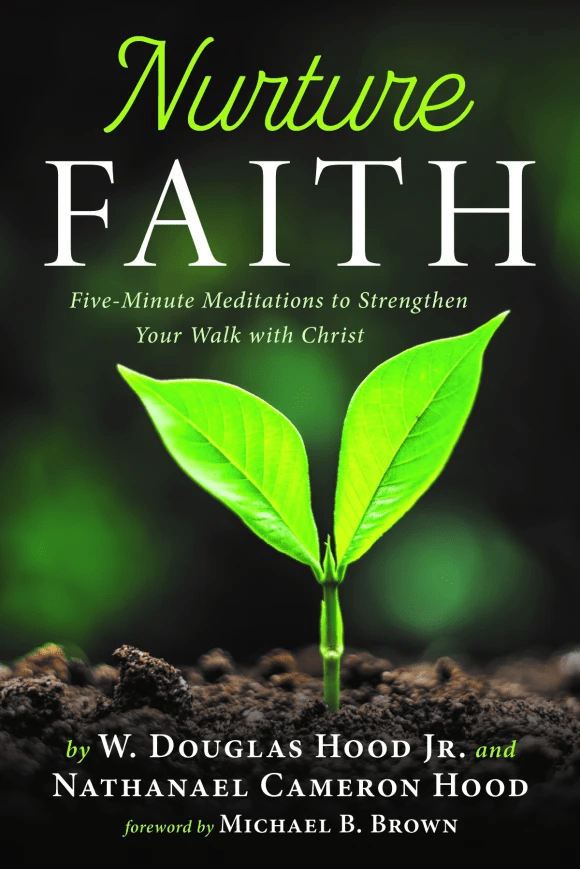
To read more meditations by Dr. Doug Hood and Nathanael Cameron Hood, you can purchase Nurture Faith: Five Minute Meditations to Strengthen Your Walk with Christ from your favorite book seller.

Any royalties received support the ministry and mission of First Presbyterian Church of Delray Beach.

Categories
Religious

Facing the Big Move

The following mediation was written by Doug Hood’s son, Nathanael Cameron Hood, a recent graduate of Princeton Theological Seminary.

They should make me a sanctuary so I can be present among them. You should follow the blueprints that I will show you for the dwelling and for all its equipment.”

Exodus 25: 8, 9 (Common English Bible)

There are few things I dislike more in life than moving. It’s not just that I dislike the boxing and the unboxing, the lifting and the sweating, the stress and the worry—although I very much do. For me, what I dislike the most is saying goodbye to old comforts and habits. Let me explain. During my last year at Princeton Theological Seminary, I lived in a wonderful room on the third floor of Brown Hall, a beautiful recently renovated dorm built in 1865. Located at the heart of the campus, the dorm was a fifteen-second walk from the cafeteria, a thirty-second walk from the main classroom building, and a ten-minute walk from Nassau Street—Princeton’s answer to New York City’s Time Square. I quickly became accustomed to these short walks for their convenience and beauty. In truth, I came to love them.

The room itself was small but large enough to accommodate an overworked student like myself. There, too, I became accustomed to its dimensions and came to love them—I loved how it was exactly seven steps from my bed to my private bathroom and less than one to my large wooden desk. I put an electric kettle for tea on the left side of the desk and sometimes—when deadlines were particularly brutal—a coffee pot on the right. Many were the days (and nights) when I would wrap myself in a blanket, sit in my chair, fire up the kettle and coffee pots, and read, study, and write for hours. Especially when soft rains or snow danced outside my window, my room became an introverted seminarian’s paradise.

But eventually, I had to say goodbye to Princeton, to the short walks I’d loved, the dorm room that became a hideaway, and the desk I’d whiled away so many afternoons and long weekends. I traded them all for an apartment in Brooklyn, where I would be spending the next year of my ministry. The move was stressful, but the hardest part was getting used to my new surroundings. Now, I had no desk, a bathroom down the hall, four roommates, and a twenty-minute walk to my new job. Small complaints, but for an introverted creature of habit like myself, they mattered.

The Book of Exodus also recounts the story of a significant move—the moving of the Hebrew people from Egypt to the Promised Land. Despite having escaped literal slavery, Exodus tells how the Hebrews quickly came to mourn their old habits and surroundings. Remember when we used to have meat and fresh vegetables, they whined. Remember how life was in the old days? There are many stories of God and Moses dealing with these complaints, but one of my favorites is the unusually specific instructions God gives for building the tabernacle, the holy ornaments, and the new priestly duties. Read in a certain light, it’s like God was giving a final response to the Hebrews’ mourning of their old lives with literal instructions for a new one. In time, the Jewish people would look back at this tabernacle as instrumental to their identity as God’s chosen people. The new had replaced the old. They just needed the courage and conviction to trust God and let go of the past. I can relate. Though I miss my old dorm, I’ve come to make my new apartment a home. I have new rituals for how I go about my days and nights, ones that I now dread leaving behind in a future move as much as I dreaded leaving my Princeton ones. And what’s more, I’m comforted knowing that I’m exactly where God needs me to be at this exact moment in my life. What could be better than that?

Joy,


To read more meditations by Dr. Doug Hood and Nathanael Cameron Hood, you can purchase Nurture Faith: Five Minute Meditations to Strengthen Your Walk with Christ from your favorite book seller.

Any royalties received support the ministry and mission of First Presbyterian Church of Delray Beach.

Categories
Religious

Our Greatest Gift to Another

“I made myself holy on their behalf so that they also would be made holy in the truth.”

John 17:19 (Common English Bible)

Jim Rohn writes, “The greatest gift you can give to somebody is your own personal development. I used to say, ‘If you will take care of me, I will take care of you.’ Now I say, ‘I will take care of me for you if you will take care of you for me.’”[i] Rohn seems to have captured wisdom from Jesus’ playbook. In a tribute to his nature and character, Jesus makes the statement, “I made myself holy on their behalf so that they also would be made holy.” Here is Jesus’ secret for maintaining intimacy with twelve irritating men who were his companions. Each disciple pledged their life to the purposes of Jesus. Yet, in one measure or another, they disrupted their fellowship with angry contention as to who came first or who was the most loved. Petty prejudices were evident in their ministry, and they fiercely attacked men who had caught the spirit of Jesus but who did not belong to their select circle.

Abandonment of such a divisive, arrogant, and argumentative bunch of men seems the most reasonable course for Jesus to take. Yes, Jesus loved them. But they also drove him crazy. Certainly, there were stronger candidates that Jesus could trust to care for his divine purposes. But right here, with this statement captured in John’s Gospel, Jesus purposed to lift them, “I made myself holy on their behalf so that they also would be made holy in the truth.” Jesus’ technique is to lift himself closer to God, on the disciples’ behalf, so that as he is changed by God’s presence, he might change the disciples. These foolish, deficient colleagues that Jesus loves are made useful by Jesus’ decision to draw closer to God. As Jesus is changed, the disciples are changed by their proximity to Jesus. There is something intensely practical here for us. Every individual is affected by a relationship they establish with another personality.

Instinctively, we become like those persons we keep company with. This becomes evident in the fashion that dress us, the amusements that entertain us, and the values we embrace. Parents know this. That is why the company their children keep becomes such an important consideration. We spend an hour with a friend, and we come away different. If the experience is less than satisfying, we are conscious of a weakening within our psyche. We question why we entertained unsavory gossip or indulged in humor that inflicts pain upon another. Then we spend an hour with another friend, and we come away with indescribable joy. The world takes on a different complexion than before, and we feel good about ourselves. The world is a beautiful place, more welcoming, more gracious, more inclusive of differences. The dynamic is the same in both cases. We are under a spell of influence.

If we do not have a satisfactory relationship with those who are closest to us, Jesus shows us what we can do about it. We can take care of ourselves—we can lift our own life closer to God until we experience a change in our own character. That change is inevitable. Moses experienced it on the mountain with God. The apostle Paul experienced it on the Road to Damascus. One life rubbing up against another results in change for both. But a life that draws near to God—and remains there for a considerable period—experiences transformation by the divine. If those who are nearest to us seem to disappoint, and seem to have lives marked by the trivial and shallow, we cannot wave aside the blame for such conditions. As Jim Rohn might say, that is the life we inspire by who we are. Take responsibility for spiritual growth and watch the change in those who are closest to you. That will be our greatest gift to another.

Joy,


[i] Jim Rohn, The Treasury of Quotes (Dallas, Texas: SUCCESS Enterprises, LLC, 1994-2021), 88.


To read more meditations by Dr. Doug Hood and Nathanael Cameron Hood, you can purchase Nurture Faith: Five Minute Meditations to Strengthen Your Walk with Christ from your favorite book seller.

Any royalties received support the ministry and mission of First Presbyterian Church of Delray Beach.

Categories
Religious

In the Face of Defeat

“When they heard this, everyone in the synagogue was filled with anger. They rose up and ran him out of town.”

Luke 4:28, 29 (Common English Bible)

Defeat is a single, devasting event. We do not experience defeat—a loss or failure that is potentially injurious to our sense of self-worth—without strenuous effort to succeed. Defeat follows intentional activity to advance forward with some worthwhile goal, some accomplishment that attracts notice from others. Yet, it is most important that we accept that defeat is a single event, not one that defines our life. Defeat is inevitable for everyone who lives purposefully. To put it more simply, defeat is nothing more than a single event in the span of a lifetime. Lives lived richly, lived with a strong drive to achieve, and add value to the world we live in often experience multiple defeats. But each defeat is a singular event. And, as has often been said, each defeat moves one closer to success.

The life of Jesus stands as the supreme example of successful living. And yet, if one pays close attention to that life, it is astonishing to find how often Jesus experienced personal defeat. Jesus did not walk along easy paths that were free of difficulty or opposition. Again and again, Jesus absorbed into himself the anguish of retreat, saw his most noble efforts crash down into ruins and knocked on the door of opportunity only to have that door remained closed. If the life to which we look to for inspiration, encouragement, and hope had to contend with reversal after reversal, defeat after defeat, perhaps we have reason to conclude that such misfortune is woven into the very fabric of life. Defeat in the pursuit of noble ends is not unusual. Defeat—even if one follows another—is not evidence of a defeated life.

Here, in this teaching from Luke’s Gospel, Jesus is teaching in the synagogue. I have sat through the teaching of many wise professors. The response of the students follows along a continuum of disinterest to applause. But not once have I observed anger as Jesus does here in Luke. Not just an expression of rage, Jesus’ students attempt to throw him off a cliff! My study Bible has placed this passage of scripture after the heading, The Rejection of Jesus at Nazareth. Jesus, the most successful life in history, receives rejection, anger, and an attempt on his life. At the end of the day, I imagine that this experience would not be placed on a resume. How did our Lord cope with this failure? Luke tells us that he escaped, went on his way, and resumed teaching. Obviously, a step in the successful treatment of defeat is to simply accept it.

It is not freedom from defeat that characterizes us. Jesus experienced defeat again and again. But rather than be classified as a loser, Jesus accepted defeat and moved on with the single purpose of his life. Undoubtedly, each defeat brought with it a sting of disappointment and discomfort. And most people probably take immediate steps to ensure that defeat is never repeated—at least not in the same fashion. Like a child that experiences pain from some activity, we learn not to repeat the same activity. Unfortunately, defeat is unavoidable for anyone who strives forward. It was unavoidable for Jesus. But Jesus’ behavior amid defeat demonstrates that defeat is not all loss. If we have the same purpose of mind as Jesus, failure and defeat cannot break us. We need only to look at Jesus.

Joy,


To read more meditations by Dr. Doug Hood and Nathanael Cameron Hood, you can purchase Nurture Faith: Five Minute Meditations to Strengthen Your Walk with Christ from your favorite book seller.

Any royalties received support the ministry and mission of First Presbyterian Church of Delray Beach.

Categories
Religious

When Our Self-Worth Stumbles

“Dear friends, now we are God’s children.”

1 John 3:2 (Common English Bible)

A major challenge faced by most of us is a preoccupation with what other people think of us. Sensitivity to the opinions of our friends and our enemies may sway from one moment to the next. Yet it remains a constant consideration. Politicians are not the only ones who have an ear to the ground or eyes on the polls. The rumblings of popular sentiment about how we are perceived are always on our radar. We crave approval and shrink from disapproval. Our mood for days is often determined by favorable or unfavorable commentary on our character, ability, or accomplishments. We form a mental picture of ourselves through the comments and opinions of those in our orbit. Our self-worth hangs upon what others think of us. The gravitation pull of even the most trifling uncomplimentary remark can result in an emotional collapse.

There may be something of value in paying attention to what others are saying about us. We live in community with one another. We are responsible for one another. Every decision, every behavior impacts the larger community in which we live and work. Most of us want to positively impact our own little portion of the world. We cannot ignore what others may say about us, nor should we. Unfavorable responses that come in our direction may provide insight for a course reset. Negative feedback can be a catalyst for rethinking our approach, our approach to friendships, work colleagues, and family. As we move forward from this day, a constant factor in life is that our yesterday does not have to be our tomorrow. We have the capacity to reflect upon favorable and unfavorable feedback and make a change.

A more fundamental question that we ought to concern ourselves with is what we think of ourselves. That question is answered by our thoughts, habits, and how we deploy our natural talents and gifts in the service of others. We form a mental picture of ourselves through our education, experiences, and fortitude to delve into challenges regardless of the perceived obstacles—real or imagined. Each one of us has limits of knowledge and ability. Yet, with desire and determination, new limits can be put in place of old ones—knowledge and understanding, and ability continually stretched. That is the power and value of attitude. But no one can surpass the limits of one’s current self-image. The mental picture of ourselves either releases energy for continued growth or imprisons us within our present ability.

For people of faith, the Bible helps those whose self-image is stuck for those moments when self-worth stumbles. John, the beloved disciple of our Lord, reminds us that “we are God’s children.” We are unable to fully comprehend God and God’s work in our lives and in the world. We are unable to know “what we will be.” (1 John 3:2b) But John reminds us that the God who created the heavens and the earth, the God who raised Jesus from the dead, claims us as God’s own children. Recalling our glorious nature as God’s own child is enough to strengthen a self-image that is weakened by the judgments of others. There is a deep tendency today to become like what we imagine ourselves to be. The one who claims us ought to matter. Since we are claimed by God, shall we not dare to think well of our value and to live by the highest thoughts?

Joy,

Categories
Religious

Religious Dropouts

“At this, many of his disciples turned away and no longer accompanied him.”

John 6:66 (Common English Bible)

It is now fairly common knowledge that Christian churches across the United States are experiencing decline—a decline in membership, decline in worship attendance, and decline in financial support. Diminishing interest in the church has resulted, in many congregations, a shift from full-time pastoral leadership to part-time, reduced opportunities for spiritual nurture and growth, and a smaller impact on the local community. As congregations grow smaller they are faced with difficult decisions such as merging with other churches or closing their doors permanently. Causes for the decline of the Christian Church across our nation have been studied and solutions have been scarce.

What has received less attention is a phenomenon I will call the “religious dropouts.” These are the people who are regularly present in services of worship, engaged in personal spiritual growth, and participate in the church’s mission to feed the hungry, house the homeless and care for the broken. Vibrant and robust churches are built upon their dedication to Jesus and Jesus’ work through the local congregation. It is not difficult to see that the church is stronger for such people. Then, they simply aren’t present anymore. The place they once occupied in worship is empty. It is a phenomenon that dates back to the earthly ministry of Jesus: “many of his disciples turned away and no longer accompanied him.”

The primary reason for the “religious dropout” remains the same from Jesus’ day until ours: frustration and disappointment. There are present in every faith community people who turn to religion for some things the Christian faith never promised to provide. They expect in religion a kind of magical solution to their problems, anxieties, and illnesses and it hasn’t worked out. Some expect that faithfulness to the church will protect them from job loss, marital discord, and safety from the violence in the world. Others look to the church to shelter their children from everything that is unpleasant and distasteful in the dominant culture. When they fail to receive what they were looking for, they are cool to religion and simply drop out.

After many who followed Jesus turned away, Jesus turned to his disciples and asked, “Do you also want to leave?” It is a good question for each one of us to ask. People who come to our churches expecting only to “get something” or find easy solutions will be frustrated and disappointed. Somehow they have missed that Jesus was betrayed, beaten, and crucified. As William Willimon once commented, why do the followers of Jesus expect to get off any better? What is required is a return to the promise that the faith has always made available: In Jesus Christ, God walks with us through the storms, difficulties, and struggles of life, strengthening us along the way. Life will take us to the depths. When we arrive, Jesus will be there. We are not alone.

Joy,

~ ~ ~ ~ ~ ~ ~ ~ ~ ~

To read more meditations by Dr. Doug Hood and Nathanael Cameron Hood, you can purchase Nurture Faith: Five Minute Meditations to Strengthen Your Walk with Christ from your favorite book seller.

Any royalties received support the ministry and mission of First Presbyterian Church of Delray Beach.

Categories
Religious

The Puzzle of Prayer

We always thank God for all of you when we mention you constantly in our prayers.”

1 Thessalonians 1:2 (Common English Bible)

It is not unusual for someone to ask me, “Please pray for me.” Often my response is an invitation to immediate prayer. My desire is to take the request for prayer seriously. By praying with the person immediately, I wish to say that I care deeply about them and that I appreciate their confidence in the power of prayer. Recently, however, I have begun to question, “Just what do they expect from this prayer?” “Do they really believe my prayer to do any good?”

Naturally, the Bible has much to say about prayer. What is often unrealized is just how frequently the mention of prayer in the Bible is one of complaint. The palmists, the prophets, Job, and the apostle Paul, often questioned the value of prayer, sometimes rather bluntly! Listen to a portion of Psalm 88, “But I cry out to you, Lord! My prayer meets you first thing in the morning! Why do you reject my very being, Lord? Why do you hide your face from me?” (Ps 13, 14) It is clear that today’s church is not the first to question the usefulness of prayer.

It is important—and helpful—to note, however, that in each complaint that is uttered, there is present a fervent belief that something can be expected from prayer. Prayer is never given up on in the Bible, never dismissed as not of any use. What makes each of those who wrestle with prayer people of amazing stature is their absolute confidence in the power of prayer—the power to disrupt at any moment the ordinary with the extraordinary. Without reserve or embarrassment, each character in the Bible shared the same compulsion to pray.

I will freely share that I have no idea how prayer works. The question itself may be foolish simply because it strives to understand God. And someone once wisely declared that if we can ever grasp God, then we must go looking for another God. Any God we can understand with our finite minds is simply too small to save us. What I am confident of is that God was very active in the drama recorded in the Bible and continues to be just as involved in the unfolding drama of life today. And God invites us, repeatedly, to seek the inflowing of God’s grace through regular prayer. Refusal to pray—even when prayer was questioned—simply was not an option for the people of faith in the Bible.

Joy,

~ ~ ~ ~ ~ ~ ~ ~ ~ ~

This mediation is from Dr. Doug Hood’s upcoming book, A Month of Prayer: Five-Minute Meditations for a Deeper Experience of Prayer, featuring prayers by Dr. Leo S. Thorne.

Categories
Religious

Which Voice Shall I Follow?

“Again the Lord called Samuel, so Samuel got up, went to Eli, and said, ‘I’m here. You called me?’”

1 Samuel 3:6 (Common English Bible)

Here is a startling story of a young boy named Samuel who had trouble sleeping one night because of a voice that spoke to him from the darkness. Most of us know that story—a voice that comes to us in the darkness at that moment when we want nothing more than to sleep. The volume of the voice is usually immense. It is a clamorous tongue that disturbs the mind and stirs physical restlessness as we lay upon the mattress. For some, the voice that speaks addresses our personal finances, most often when our financial resources are running low and our commitments are racing in the opposite direction. For others, the voice reminds us of estranged relationships but offers no solutions for healing. Other voices that bombard the mind’s ear simply wish to generate anger at this or that political party and the absolute stupidity—or cruelty—of this or that policy out of Washington. Solutions rarely show up in the darkness of the bedroom. Neither does sound sleep.

Here, young Samuel is lying down in the Lord’s temple. We know it is the night hour because fifteen verses later we are informed, “Samuel lay there until morning.” But Samuel will not sleep that night. Before his mind drifts off to restful sleep, Samuel hears a voice. It is the Lord’s voice but Samuel doesn’t know that—not in the beginning. He believes the voice belongs to his mentor, Eli. Three times Samuel hears the voice and three times Samuel disturbs Eli to inquire what it is Eli wants. It is the third time that Eli grows suspicious that this is more than Samuel’s imagination. Nor is Samuel simply hearing the whistle of the wind. Samuel is instructed to make an inquiry if he hears the voice again; to say, “Speak, Lord. Your servant is listening.” And the voice does return.

This is precisely the point that Samuel makes a rather dramatic shift from simply jumping from his bed at the sound of a voice to careful listening. Samuel restrains his natural impulse to a quick response and practices alert and intentional discernment of the content of the voice that speaks. There is much all of us can learn from this simple act—pausing long enough to sincerely listen to the voice we hear, particularly if that voice is unsettling to us. What would happen in our nation if Republicans and Democrats were to exercise restraint from the vitriolic impulse they have for one another? Imagine the surprise if Evangelicals and liberals in the Christian church ever truly listened to one another. What might any of us discover in the darkness of the night if we calmly listened to all that unsettles us—personal finances, relationship difficulties, or concern for the health of those we love—and then, rather uncommonly, invited another voice to the conversation, “Speak, Lord. Your servant is listening.”

At any moment of the day or night, there are voices that clamor for our attention. Some voices long for an impulsive response from us, usually a response that multiplies anger and hurt and fears among those we know and love. Perhaps a voice asks from us indignation and puerile criticism of another point of view. The only contribution that voice makes is increased brokenness in an already broken world. Do not trust these voices. But Samuel’s story shows us another way. Eli counsels Samuel to “listen” rather than “jump” at the sound of the voice. If we listen and listen with humility and civility and respect, what we will discover is that the voices that clamor for an impulsive response will scatter and one will remain. It will be the loveliest voice of all. It will be a voice that asks for patience and love. Trust that voice. Ponder it. Respond to it. It will be then that you have in your heart neither doubt nor fear.

Joy,

~~~~~~~~~~~~~~~~~~~~~~~~

To read more meditations by Dr. Doug Hood and Nathanael Cameron Hood, you can purchase Nurture Faith: Five Minute Meditations to Strengthen Your Walk with Christ from your favorite book seller.

Any royalties received support the ministry and mission of First Presbyterian Church of Delray Beach.

Categories
Religious

Is Belief in a Personal God Possible?

For many, the most challenging part of faith is belief in a personal God. Membership in a local church usually requires “a profession of faith.” Often, this is little more than mental consent that there is a God. That same consent to God’s existence usually assumes that the individual intends to place themselves under God’s authority. Yet, what is often present in that “profession” is a sincere desire to know God personally, to experience a relationship with God in such a manner that in those hours of deepest need, we may personally address God and feel that we are heard and cared for. Harry Emerson Fosdick is helpful here, “No one achieves a vital, personal, Christian experience without a profound sense of need.”[1] But the question presses, is belief in a personal God possible?

One difficulty in experiencing a personal God today is the tendency of impersonal thinking and living. Anything sensory is found to be inferior to reason and intelligence. During my ministry in Texas a number of years ago, one individual criticized my preaching as too personal and too emotional. He was a medical doctor and sought sermons that would stretch his thinking, not move his heart. He was suspicious of preaching that stirred emotions. To think of God in personal terms, he argued, was unsophisticated. I suspect that the Sunday morning pews are filled with people who are in agreement.

But look at what Jesus does here for his disciples: Jesus takes the qualities of human parenting as a clue to understanding God; asks that we address God as Father. God is not an impersonal force that moves through the universe. God is a living being that knows us, loves us, and has a divine desire for our lives. Jesus draws from what is the best in our hearts to show us its higher ideal in God. Certainly, it is true that God has given us minds and expects that we should be growing in knowledge. But we cannot pursue God and fully know God without the heart. One of the basic convictions of our Christian faith is that a loving purpose directs the universe.

Moments confront each of us that demand more than a mere belief in the existence of God. They are moments of such great personal need that more study—more knowledge about God—fails to satisfy. A calm strength in the midst of life’s storms is possible only as God is known personally. The Christian lives not by a higher knowledge of God. The Christian lives by faith, prayer, love, and communion with God. When the soul cries out for a personal God, Jesus shows us the way. It is so simple we doubt its power. Get down on your knees, patiently silence all the voices in your mind, and then say, “Our Father, who is in Heaven.”

Joy,


[1] Harry Emerson Fosdick, Riverside Sermons, New York: Harper & Brothers, 1958, 168.

~~~~~~~~~~~~~~~~~~~~~~

This mediation is from Dr. Doug Hood’s upcoming book, A Month of Prayer: Five-Minute Meditations for a Deeper Experience of Prayer, featuring prayers by Dr. Leo S. Thorne.

Categories
Religious

Faithful Complaining

The following mediation was written by Nathanael Cameron Hood, MA, New York University; MDiv, Princeton Theological Seminary

“After the Lord had said these words to Job, he said to Eliphaz from Terman, ‘I am angry with you and your two friends because you haven’t spoken about me correctly as did my servant Job.’”

Job 42:7 (Common English Bible)

When I first went to grad school at New York University in the early 2010s, I became friends with an aspiring PhD student who didn’t have much regard for organized religion. He was a good man—a genius student and doting father with whom I could talk for hours about politics and art. But whenever the subject of faith arose, his entire mood would change. On good days he’d become tight-lipped and dismissive—on bad ones, he could become outright belligerent. Few such memories stick in my mind quite like one morning when he told me that he’d finished rereading the Book of Job and had decided that the God depicted within was one of the greatest villains in literary history. He snarled that he couldn’t believe anyone could worship a God who would inflict such suffering on such a good man, give him no satisfactory explanation why, and only restore his fortunes once he apologized for complaining.

Over a decade later, I still think about this conversation all the time—not because he offended me, but because I often find myself agreeing with him. The Book of Job is one of the most challenging texts in the entire Bible, inspiring passionate, puzzled, furious debate for literal millennia. Some scholars suggest it began life as an Israelite folk tale that tried to rationalize the existence of evil in God’s creation. As the centuries went by, bits and pieces were Frankensteined into the text until it resembled its current, seemingly chaotic form. One of their key bits of evidence is the book’s epilogue in the forty-second chapter where—after Job repents for rebuking God—God turns around and chastises Job’s assembled friends who’d spent dozens of chapters defending God’s goodness, declaring that Job was the only righteous one among them. The only way to explain such an abrupt 180° reversal, these scholars declare, was that different writers had meddled with the original story to help Job—and God—save face.

One would think my recent time in the scholarly trenches of seminary would see me agreeing with these arguments. But curiously, I’ve found the opposite to be true. I wonder if these researchers are missing the forest for the trees, failing to grasp that within the larger biblical story of God revealing Godself to humanity it really was Job who proved himself the most faithful because of his willingness to challenge God. Consider Job’s friends—the quick-witted Eliphaz, the accusatory Bildad, the cutting Zophar, the impetuous Elihu. In their rush to defend God from Job they ended up reducing God into a static set of rules to be blindly followed. Ah, but our God is much more than this! Though God desires our obedience, what God wants more than anything else is a personal relationship with each of us. This is why God came to earth as a human being—to live with us, to celebrate with us, to cry and suffer and ultimately die with us.

All throughout the Bible we see righteous men and women struggle with God, refusing to be silent in the face of perceived injustice and evil: Jeremiah cursing God for dooming Jerusalem, the Psalmist despairing of God’s absence, the writer of Ecclesiastes dismissing all creation as meaningless. Even Jesus challenged God at Gethsemane, begging his father to save him from the suffering that was to come on the cross. In a way, it takes more faith to assume that God will hear and respond to our complaints and petitions than to blindly accept our suffering and misfortunes as God’s will. To think otherwise would diminish God, just as Job’s friends did in the strange, infuriating, and ultimately beautiful Book of Job.

Joy,

~~~~~~~~~~~~~~~~~~~~~~

To read more meditations by Dr. Doug Hood and Nathanael Cameron Hood, you can purchase Nurture Faith: Five Minute Meditations to Strengthen Your Walk with Christ from your favorite book seller.

Any royalties received support the ministry and mission of First Presbyterian Church of Delray Beach.