Categories
Religious

When Faith Is Difficult

“We can’t find goodness anywhere.”

Psalm 4:6 (Common English Bible)

If there remains anyone who argues that the Bible isn’t relevant for today, they have demonstrated that they haven’t paid attention to the Bible—not close attention, anyway. Is there anything more timeless than the agonizing cry, “We can’t find goodness anywhere?” Each morning our minds are disturbed by the growing threat of the militant Islamic group, ISIS, the conflict between Israel and Palestine, and the racial unrest in Ferguson, Missouri. Beneath these attention-getting headlines is the less-mentioned but the continuing concern of the growing wealth gap in our country and the millions in our nation who struggle daily to simply have enough. There are no snappy answers to the painful question of human struggle.

It is well that the Bible does not offer a quick and pre-fabricated answer to this despairing cry. And it is best for us to refrain from such a temptation. First, we are not free to indulge in cynical or dismissive attitudes such as, “Well, that’s life,” or “Bad things just happen.” As followers of Jesus, we are baptized into the common confession that our lives are in the hands of God and that this God is a God of love. Second, we don’t occupy some place between God and humanity’s struggle. Not one of us has some special insight into the mysterious work of God in the midst of our common difficulty. Each of us must sweat it out with everyone else.

What remains is a prayer: “Lord, show us once more the light of your face.” This is the prayer of the Psalmist, and nothing new can be added. The prayer is the same today as it was yesterday, fresh and urgent. It is as new as the earthquake that shook the San Francisco Bay Area a few days ago and the agony that kept someone awake last night. It is new when we utter it personally today. No devotional, not one inspirational book can answer the plea, the emotional depth of that prayer.

On our knees, we pray. If we listen in the silence between our words, the Holy Spirit reminds us that God was never absent in the horrors of human life in the Bible—nor will God be absent today. On the Via Dolorosa—the way of the cross—in Jerusalem, God was very present in the heart of human misery, giving, giving, and giving himself so that after this, there would be no fear, no despair, and no doubt of God’s love. The cry, “We can’t find goodness anywhere,” still sounds in the streets of our communities. We live with it, and we hear it echo in our souls. But the spirit helps us recall the suffering of Christ—a suffering accepted out of Christ’s love for us. It is a love that will work for the good of all those who love him.

Joy,


This meditation is from Dr. Doug Hood’s soon to be published book, “A Month of Prayer: Five Minute Meditations for a Deeper Experience of Prayer”.

Categories
Religious

In the Face of Defeat

“When they heard this, everyone in the synagogue was filled with anger. They rose up and ran him out of town.”

Luke 4:28, 29 (Common English Bible)

Defeat is a single, devasting event. We do not experience defeat—a loss or failure that is potentially injurious to our sense of self-worth—without strenuous effort to succeed. Defeat follows intentional activity to advance forward with some worthwhile goal, some accomplishment that attracts notice from others. Yet, it is most important that we accept that defeat is a single event, not one that defines our life. Defeat is inevitable for everyone who lives purposefully. To put it more simply, defeat is nothing more than a single event in the span of a lifetime. Lives lived richly, lived with a strong drive to achieve, and add value to the world we live in often experience multiple defeats. But each defeat is a singular event. And, as has often been said, each defeat moves one closer to success.

The life of Jesus stands as the supreme example of successful living. And yet, if one pays close attention to that life, it is astonishing to find how often Jesus experienced personal defeat. Jesus did not walk along easy paths that were free of difficulty or opposition. Again and again, Jesus absorbed into himself the anguish of retreat, saw his most noble efforts crash down into ruins and knocked on the door of opportunity only to have that door remained closed. If the life to which we look to for inspiration, encouragement, and hope had to contend with reversal after reversal, defeat after defeat, perhaps we have reason to conclude that such misfortune is woven into the very fabric of life. Defeat in the pursuit of noble ends is not unusual. Defeat—even if one follows another—is not evidence of a defeated life.

Here, in this teaching from Luke’s Gospel, Jesus is teaching in the synagogue. I have sat through the teaching of many wise professors. The response of the students follows along a continuum of disinterest to applause. But not once have I observed anger as Jesus does here in Luke. Not just an expression of rage, Jesus’ students attempt to throw him off a cliff! My study Bible has placed this passage of scripture after the heading, The Rejection of Jesus at Nazareth. Jesus, the most successful life in history, receives rejection, anger, and an attempt on his life. At the end of the day, I imagine that this experience would not be placed on a resume. How did our Lord cope with this failure? Luke tells us that he escaped, went on his way, and resumed teaching. Obviously, a step in the successful treatment of defeat is to simply accept it.

It is not freedom from defeat that characterizes us. Jesus experienced defeat again and again. But rather than be classified as a loser, Jesus accepted defeat and moved on with the single purpose of his life. Undoubtedly, each defeat brought with it a sting of disappointment and discomfort. And most people probably take immediate steps to ensure that defeat is never repeated—at least not in the same fashion. Like a child that experiences pain from some activity, we learn not to repeat the same activity. Unfortunately, defeat is unavoidable for anyone who strives forward. It was unavoidable for Jesus. But Jesus’ behavior amid defeat demonstrates that defeat is not all loss. If we have the same purpose of mind as Jesus, failure and defeat cannot break us. We need only to look at Jesus.

Joy,


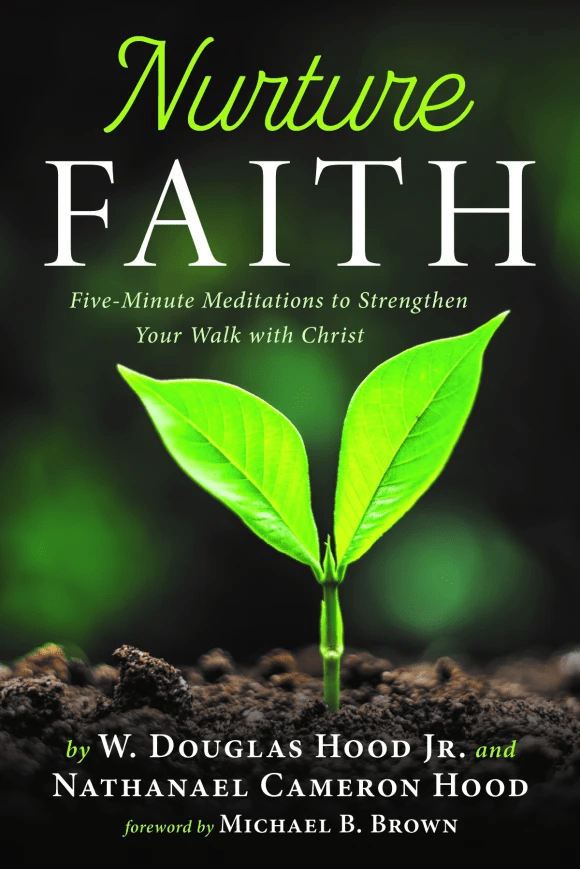
To read more meditations by Dr. Doug Hood and Nathanael Cameron Hood, you can purchase Nurture Faith: Five Minute Meditations to Strengthen Your Walk with Christ from your favorite book seller.

Any royalties received support the ministry and mission of First Presbyterian Church of Delray Beach.

Categories
Religious

When Our Self-Worth Stumbles

“Dear friends, now we are God’s children.”

1 John 3:2 (Common English Bible)

A major challenge faced by most of us is a preoccupation with what other people think of us. Sensitivity to the opinions of our friends and our enemies may sway from one moment to the next. Yet it remains a constant consideration. Politicians are not the only ones who have an ear to the ground or eyes on the polls. The rumblings of popular sentiment about how we are perceived are always on our radar. We crave approval and shrink from disapproval. Our mood for days is often determined by favorable or unfavorable commentary on our character, ability, or accomplishments. We form a mental picture of ourselves through the comments and opinions of those in our orbit. Our self-worth hangs upon what others think of us. The gravitation pull of even the most trifling uncomplimentary remark can result in an emotional collapse.

There may be something of value in paying attention to what others are saying about us. We live in community with one another. We are responsible for one another. Every decision, every behavior impacts the larger community in which we live and work. Most of us want to positively impact our own little portion of the world. We cannot ignore what others may say about us, nor should we. Unfavorable responses that come in our direction may provide insight for a course reset. Negative feedback can be a catalyst for rethinking our approach, our approach to friendships, work colleagues, and family. As we move forward from this day, a constant factor in life is that our yesterday does not have to be our tomorrow. We have the capacity to reflect upon favorable and unfavorable feedback and make a change.

A more fundamental question that we ought to concern ourselves with is what we think of ourselves. That question is answered by our thoughts, habits, and how we deploy our natural talents and gifts in the service of others. We form a mental picture of ourselves through our education, experiences, and fortitude to delve into challenges regardless of the perceived obstacles—real or imagined. Each one of us has limits of knowledge and ability. Yet, with desire and determination, new limits can be put in place of old ones—knowledge and understanding, and ability continually stretched. That is the power and value of attitude. But no one can surpass the limits of one’s current self-image. The mental picture of ourselves either releases energy for continued growth or imprisons us within our present ability.

For people of faith, the Bible helps those whose self-image is stuck for those moments when self-worth stumbles. John, the beloved disciple of our Lord, reminds us that “we are God’s children.” We are unable to fully comprehend God and God’s work in our lives and in the world. We are unable to know “what we will be.” (1 John 3:2b) But John reminds us that the God who created the heavens and the earth, the God who raised Jesus from the dead, claims us as God’s own children. Recalling our glorious nature as God’s own child is enough to strengthen a self-image that is weakened by the judgments of others. There is a deep tendency today to become like what we imagine ourselves to be. The one who claims us ought to matter. Since we are claimed by God, shall we not dare to think well of our value and to live by the highest thoughts?

Joy,

Categories
Religious

A Real and Vital Faith

“Happy are people who have pure hearts, because they will see God.”

Matthew 5:8 (Common English Bible)

Jesus teaches, “Happy are people who have pure hearts, because they will see God.” The “pure heart” is a faith that is “backed up by convictions, whose outward deeds match their inner commitments.”i  What Jesus is saying is that those who have “pure hearts” will have a faith that is real and vital. It is a faith experienced in the deep recesses of the heart, a faith that influences every moment of our lives. Such a faith confronts the God of the Holy Bible as an inescapable reality. Vagueness and doubt dissipates, senses become alert as though biting into something hot and spicy, and confidently we know that God is right in the midst of the present moment. 

This is not a faith that simply believes in God or has opinions about God. The church has multitudes of people who do that. It is one thing to recite the creeds of the church and utter words of belief, as almost all of us do. It is quite another thing to say, “God is in this place! I feel God’s presence.” That experience is like taking notice of a beautiful piece of art, imagination stirred by the rich use of colors or the complexity of brush strokes or standing on a beach watching a sunrise as if you had never seen one before. No one argues with a beautiful piece of art or with a sunrise. It is simply experienced.

The critical difference is awareness. Consider a conversation I had some years ago in Pasadena, California. During my graduate studies there, I commented to a resident what a joy it is to wake each morning, pour a cup of coffee, and enjoy the beautiful mountain range. At that comment, my friend looked-up at the mountains, with no discernable emotion, and said, “After living here for a while, you no longer notice them.” My friend acknowledged the presence of the mountains but they were not real to him. He had lost his capacity to notice them and have them move him deeply by the beauty that they generously shared day after day. His heart was not pure. Rather, his heart, muddied by the multitude of the small and large things that occupied his thoughts, fell numb.

Anything real to us results in emotional vividness. If such emotion is absent, we may question if we are paying attention, eyes wide open expecting the unexpected and anticipating wonder. Belief can be a profound matter, even courageous when such statement of belief may result in marginalization or persecution. However, often our beliefs lie at the surface of our lives, very present but lacking any meaningful impact on us. Perhaps attention to responsibility, to fulfilling daily tasks, or simply cynicism and exhaustion of the daily grind has narrowed our focus. Experiencing the uncommon in the ordinary requires a pure heart, that is, a heart released on occasion from the urgent tasks always before us, and open to the nuances of the present moment. It is what the Bible speaks of as stillness before God. Such a heart sees God in a child playing, in nature, in ordinary situations, and in opportunities to be useful to others. 

Joy,

_________________________

i Thomas G. Long, Matthew, (Louisville, Kentucky: Westminster John Knox Press, 1997) 50.

Categories
Religious

The Plain and Simple Gospel

“‘Come, follow me,’ he said, ‘and I’ll show you how to fish for people.'”

Matthew 4:19 (Common English Bible)

We are all living a deeply entangled, complex life. As complexity increases, so does our exhaustion. We run faster, master complex planning calendars that were designed to make life less cumbersome, and come to the end of many days feeling that we have been defeated. Present is a growing nostalgia for a simpler world—a desire for a plainer, clearer path forward. This general desire includes the spiritual realm. The hope is that the church would provide a rediscovery of God, reclaiming God’s strength for daily living, and direction for a larger purpose to which we may attach our lives. Unfortunately, what many find are cumbersome requirements for membership and multiple invitations to serve on committees that multiple our exhaustion. With church participation, we discover that there are now more oars in the water that requires our attention.

How can we return to a simpler time? Jesus is instructive. Notice that Jesus does not invite people to register for a six-week member class. Jesus does not make committee assignments. Jesus does not examine doctrinal purity or demand conformity to creedal statements. Jesus quite simply asks that we follow him. To follow Jesus is to share life with Jesus in the fullest sense: to go where he goes, to listen to what he taught, and to participate in practices and disciplines that were important to him. An invitation to follow is the suggestion that there is something of value to be found. Naturally, to accept such an invitation begins with an acknowledgment that the present life isn’t working anymore. Unless we really believe that another approach to life is required, we will continue trying to make the present one work.

The one other thing that Jesus asks for is a posture of humility, a desire to learn, and a willingness to participate in Jesus’ work: “and I’ll show you how to fish for people.” All the work of Jesus is about one thing—looking for those who have wandered far from God and bringing them back home to the Father. As with any great work, there are multiple functions that must be accomplished. None of us are asked—or equipped—to do them all. Some of us are to be teachers, some will show hospitality, and others will be administrators, caregivers, and evangelists. Others will provide care and comfort to the broken. The various jobs to be done are many. But one goal remains: “to fish for people” so that they may return to God. Jesus will show us the way.

None of this suggests that boards and committees are without value to Jesus. Leadership boards must be populated with those who have demonstrated the capacity to respond to the promptings of God, to show people where Jesus is moving, and to call them to follow. Committees provide a responsible means for organizing a great workforce for accomplishing all that Jesus seeks to do in a particular community. But, in this over-complicated world, the church must not add unnecessary complexity to the simple call of Jesus to follow him and to participate with him in his grand redemptive purposes: a cup of cold water to the thirsty, a helping hand on the roadside, an encouraging word softly spoken. There are all within our reach. Nor are we called to carry the whole world on our backs. Our chief function is to point to the one who does, Jesus Christ. That is the Gospel, plain and simple.

Joy,

Categories
Religious

Where to Begin

“Rather, you will receive power when the Holy Spirit has come upon you, and you will be my witnesses in Jerusalem, in all Judea and Samaria, and to the end of the earth.”

Acts 1:8 (Common English Bible)

When the king in Alice in Wonderland was asked where to begin, he said gravely, “Begin at the beginning… and go on till you come to the end: then stop.” Begin at the beginning. Naturally, that guidance seems reasonable. That is, until you have to actually open your mouth, and speak. With thoughts racing from one place to another, it quickly becomes apparent that there are many fine places to begin. Jesus tells his disciples, here in Acts, “you will be my witnesses.” Where do the disciples begin? Where are we to begin? Sharing our faith in Jesus seems reasonable until we actually confront that moment – that moment when we are asked, “Who is Jesus?”

That moment came to me one Easter morning. I was enjoying breakfast in a Doylestown, PA diner, looking over the message I would preach in just a few hours. Mary, the waitress assigned to the table where I was seated, approached with coffee and said, “I guess this is your big day, pastor!” “I guess so,” I remarked. Then Mary asked, “What is Easter all about anyway?” Initially, I dismissed her question, not thinking she was serious. But I was mistaken; Mary was very serious. It was then I took the time to really notice her, to look into her eyes and really see her. I will not forget those eyes – eyes that betrayed her silence; silence of considerable pain. “Where do I begin?” I thought. I began with her pain. “Easter means that you can stop beating yourself up. Whatever guilt you may have now, whatever mistakes you have made in life, Easter means that you are to stop immediately from beating yourself up. God has removed it all.”

“But there is more,” I said to Mary. “Easter is an invitation to pay attention to Jesus.” I shared with Mary that as she paid attention to Jesus, by reading of him in the Bible, she will discover that she will want to be more than she is now. “Pay attention long enough to Jesus and you will experience a compulsion to be something more; you will begin to live differently.”  Mary needed to hear that Jesus doesn’t leave a life unchanged. Any significant time spent with Jesus always results in a desire to be made new. “Your whole world will appear different. You will want to be different.”

“Finally, Mary, begin to follow Jesus as you learn about him.” I shared with her that what that means is to “do what he asks in his teaching.” Imagine Jesus as a mentor in life and do everything that is asked of you. Something inexplicable happens when someone commits to doing all that Jesus’ asks: they receive an uncommon power to do so. People who obey all that they understand of Jesus’ teachings receive a power from outside of themselves; a power that actually makes them something so much more than what they were. Mary began to cry and asked how to begin. That is when I knew I had come to the end. And there, in a diner in Doylestown, PA, Mary gave her life to Jesus.

Joy,

Categories
Religious

A Christian’s Strength

“I can endure all these things through the power of the one who gives me strength.”

Philippians 4:13 (Common English Bible)

What is so remarkable about these words is that they are spoken by a man in chains. Paul is a prisoner in Rome. In a life dedicated to serving Christ, Paul has endured much – shipwreck, ridicule, hunger, and excruciating poverty. Now he sits in a Roman prison and writes that whatever the circumstances, Paul has learned the secret of inner strength and contentment. Perhaps even more remarkable, Paul lays aside his own needs and concerns to write a deeply personal letter to the Philippians to encourage them in their faith. Despite his imprisonment and impending trial, Paul’s one desire is to share with the church in Philippi that joy and strength does not come from outward circumstances but from an intimate relationship with Jesus. That power is so tremendous and so available that Paul feels he can face anything knowing that nothing can diminish his spirit. His spirit was invulnerable. Paul wants the Philippians to utilize that same power.

The interesting thing about the New Testament is that we find that same power animating most of the early Christians. A profession of faith in Jesus usually pushed people to the margins of their communities. Families were torn apart – mothers and daughters, fathers and sons no longer in relationship with one another because one or the other decided to become a follower of Jesus. Worship services were conducted in secret and often disrupted by Jewish leaders eager to destroy the Jesus movement. The worst tortures that could be imagined were invented and performed to discourage participation in the new Christian faith. There was every reason for ignoring the swelling growth of the Christian Church, keeping your head down and simply avoiding trouble. Yet, for all the compelling reasons to remain separate from those following Jesus, men and women who risked believing in Jesus made one dominating impression wherever they went, the impression of uncommon power.

That power has not been withdrawn. It is not a closely guarded secret. Where men and women continue to take Christ’s attitude of loving others and serving others that same power is unmistakable. What is troubling is that few would say that the Church today impresses the world with the same power as it once did. Somehow those who claim discipleship to Jesus Christ show little evidence of a changed life, a life of uncommon power. Absent in many Christians today is a sense of adequacy for meeting challenge and adversity. Membership and attendance decline of the Christian Church has been tracked and documented for many years now. This has resulted is the publication of resources to perfect the church’s hospitality, increase the vitality of its worship, and harness the power of technology. However valuable these may be, the most urgent need is for followers of Jesus Christ to get back to that power which is possessed by the daily nurture of a personal fellowship with Jesus.

Return for a moment to the first two words above, “I can.” Some years ago I was working with a personal trainer, Michael Bishop. One particular day he had me on my back, bench pressing what seemed to be an incredible weight for me. After pushing the bar above my head several times I did a controlled drop of the bar to my chest. I was depleted. I delivered an eye message to him to remove the bar from my chest. I will never forget his response, “That’s not my bar. You place it back on the upright supports.” Then he did what his training taught him to do. He placed his hands around the bar with my own. That was simply to ensure that I didn’t hurt myself. But the lifting belonged to me. I pushed with everything in me; I summoned all the power I could to lift the bar back onto the supports. As my strength began to fail, he matched the loss of my strength with his own until the bar had returned to rest on the support. Paul writes, “I can, through the power who gives me strength.” If you are depressed or in trouble say, “I can in Him” and you will find God’s strength come alongside your own. If you struggle with passions or addictions that frighten you, or if you feel that you are losing your grip on life, say, “I can in Him” and you will discover an unseen hand on the bar with your own, matching your strength. The Christian’s strength begins with, “I can.”

Joy,

The above meditation was taken from Dr. Doug Hood’s new book, Nurture Faith: Five Minute Meditations to Strengthen Your Walk with Christ, volume 2, coming to your favorite online book seller in early September.
Categories
Religious

A Call to Prayer

“Early in the morning, well before sunrise, Jesus rose and went to a deserted place where he could be alone in prayer.”

Mark 1:35 (Common English Bible)

My grandmother kept a large, white, faux leather cover Bible prominently in her home – usually on a coffee table, though she would occasionally move it about her home as though it was a traveling exhibit. Embossed into the cover was a full color picture of Jesus kneeling by a great rock in the wilderness. Each time my eyes fell upon that Bible I felt as though it was a call to prayer. The face of Jesus was not anxious, not desperate as my own on those occasions I did pray. His face portrayed a confidence, a radiance one has in the company of loved ones who care deeply about us.  Absent was worry, or doubt, or any trace of anxiety that threaten to consume. Yes, a call to prayer was evident in this picture of Jesus. However, that call made me uncomfortable – uncomfortable because I would experience a lack of spiritual power. With the disciples, I heard my own heart say, “Lord, teach us to pray like that.”

In this scripture, Jesus had just finished a hard, demanding day. Another day of similar demands stretched before him. How could Jesus be ready for it? Mark’s Gospel gives us the answer and with it an important insight to Jesus’ power, “Early in the morning, well before sunrise, Jesus rose and went to a deserted place where he could be alone in prayer.” Jesus was intentional with prayer. Jesus wove into the fabric of each day a time to be alone with God. Jesus regarded this time a vital part of the human experience, however one may attempt to define or understand prayer. Prayer was an opportunity to link his life with the purposes of God and cultivate a friendship with God. This friendship produced the confidence that Jesus would not face any of life’s demands alone. That would be the source of Jesus’ spiritual power.

My lack of spiritual power as a child was from an inadequate view of prayer. I had reduced prayer to those occasions when I would ask God for a favor or for help with a difficulty. Consequently, days without prayer would pass – I simply did not have any request to make of God. Yet, as I matured, I continued to pay attention to that picture on my grandmother’s Bible, that picture of Jesus at prayer. It grew upon my consciousness that prayer is the same as time spent with a friend or loved one. I may not have anything to ask of my friend but I did enjoy their company. I felt valued by them, loved by them, strengthen because of their friendship. The same happens with prayer. A strong hand upon the shoulder, a confidence to face each day swelling within. Power comes as we find ourselves surrounded by God’s love, and guidance, and strength.   

With this refreshing surge of power that flows from regular time in prayer it is very strange then that we should be content with so little prayer. The weakest, most fearful individual can experience greater strength by the regular rhythm of prayer each day. As this passage of scripture demonstrates, prayer each day for Jesus was as ordinary as enjoying a meal. Jesus prayed often. Jesus prayed for himself and for others. Jesus prayed when he faced a crisis and Jesus prayed simply to be alone with God. Jesus urged his disciples to pray and Jesus taught prayer by example. What the disciples discovered is that regular prayer did not only sustain Jesus’ ministry, it gave direction. Immediately after Jesus rose from prayer this particular morning, Jesus knew what he must do that day. He was not to return to the previous day’s work. Jesus was to head in the other direction. God had new work for him there.         

Joy,

Categories
Religious

Not Waiting for Happiness

The following meditation is from Doug Hood’s upcoming book, Nurture Faith: Five Minute Meditations to Strengthen Your Walk with Christ, vol. 2

“I’m not saying this because I need anything, for I have learned how to be content in any circumstance. I know the experience of being in need and of having more than enough; I have learned the secret to being content in any and every circumstance, whether full or hungry or whether having plenty or being poor. I can endure all these things through the power of the one who gives me strength.”

Philippians 4:11-13 (Common English Bible)

Have you noticed how many people have delayed their happiness? They seem to believe that if they can achieve a little more success, acquire a little more wealth, or marry the right person then they will possess happiness. Happiness, they believe, is what follows effort, and time, and, perhaps, a little luck. It is as though happiness is somewhere out in front of everyone who is industrious enough to pursue it. Happiness is something to grasp, they believe, and their minds remain fixed upon it until they have taken ownership of it. Striving day upon day toward the possession of happiness, what they miss is that the secret of happiness is already present in the lives of those who long for it.

Paul’s letter to the Philippian Church provides the secret of happiness – as God’s people, we are to live in humility, looking out for others more than for ourselves. That is a great reversal of the commonly accepted formula for happiness. Essentially, Paul teaches that if we are always chasing after happiness, happiness always remains beyond our grasp. On the other hand, if we occupy ourselves with looking out for others, adding value to other people and promoting their welfare, happiness quietly joins God’s people and takes-up residence in them. Paul is urging God’s people to break free of the tiny little world of themselves and join the great enterprise of God’s work in the world.

Here, in the fourth chapter of Paul’s letter to the Philippian Church, Paul further develops the secret to happiness. Having shared the secret of happiness, disclosed in the activity of Jesus who accepted humility to become like us, for the purposes of restoring us to God, Paul points to a mysterious strength that converges in our service to one another. That strength comes not from any person – or from the community of God’s people – but from the outside. It is God’s strength. There is far more going on when God’s people join with one another for the promotion of the welfare of others. The same Christ who became human to serve now empowers and enables God’s people in their service to one another.

Shortly following the death of his wife, J. R. Carmichael entered a nursing home. Yet, if you inquired about him, you learned that he is never in his room. It seems that each morning Mr. Carmichael would shower, dress, eat breakfast, and then move from one residential room to another. In each room, Mr. Carmichael spoke with the resident about their family, read the Bible to them, prayed with them, and told them that he loved them. Then it was off to the next room to do the same thing. Mr. Carmichael missed his wife every day but he never waited for happiness. Happiness found him, as he loved others deeply.

 Joy,