Categories
Religious

In the Face of Defeat

“When they heard this, everyone in the synagogue was filled with anger. They rose up and ran him out of town.”

Luke 4:28, 29 (Common English Bible)

Defeat is a single, devasting event. We do not experience defeat—a loss or failure that is potentially injurious to our sense of self-worth—without strenuous effort to succeed. Defeat follows intentional activity to advance forward with some worthwhile goal, some accomplishment that attracts notice from others. Yet, it is most important that we accept that defeat is a single event, not one that defines our life. Defeat is inevitable for everyone who lives purposefully. To put it more simply, defeat is nothing more than a single event in the span of a lifetime. Lives lived richly, lived with a strong drive to achieve, and add value to the world we live in often experience multiple defeats. But each defeat is a singular event. And, as has often been said, each defeat moves one closer to success.

The life of Jesus stands as the supreme example of successful living. And yet, if one pays close attention to that life, it is astonishing to find how often Jesus experienced personal defeat. Jesus did not walk along easy paths that were free of difficulty or opposition. Again and again, Jesus absorbed into himself the anguish of retreat, saw his most noble efforts crash down into ruins and knocked on the door of opportunity only to have that door remained closed. If the life to which we look to for inspiration, encouragement, and hope had to contend with reversal after reversal, defeat after defeat, perhaps we have reason to conclude that such misfortune is woven into the very fabric of life. Defeat in the pursuit of noble ends is not unusual. Defeat—even if one follows another—is not evidence of a defeated life.

Here, in this teaching from Luke’s Gospel, Jesus is teaching in the synagogue. I have sat through the teaching of many wise professors. The response of the students follows along a continuum of disinterest to applause. But not once have I observed anger as Jesus does here in Luke. Not just an expression of rage, Jesus’ students attempt to throw him off a cliff! My study Bible has placed this passage of scripture after the heading, The Rejection of Jesus at Nazareth. Jesus, the most successful life in history, receives rejection, anger, and an attempt on his life. At the end of the day, I imagine that this experience would not be placed on a resume. How did our Lord cope with this failure? Luke tells us that he escaped, went on his way, and resumed teaching. Obviously, a step in the successful treatment of defeat is to simply accept it.

It is not freedom from defeat that characterizes us. Jesus experienced defeat again and again. But rather than be classified as a loser, Jesus accepted defeat and moved on with the single purpose of his life. Undoubtedly, each defeat brought with it a sting of disappointment and discomfort. And most people probably take immediate steps to ensure that defeat is never repeated—at least not in the same fashion. Like a child that experiences pain from some activity, we learn not to repeat the same activity. Unfortunately, defeat is unavoidable for anyone who strives forward. It was unavoidable for Jesus. But Jesus’ behavior amid defeat demonstrates that defeat is not all loss. If we have the same purpose of mind as Jesus, failure and defeat cannot break us. We need only to look at Jesus.

Joy,


To read more meditations by Dr. Doug Hood and Nathanael Cameron Hood, you can purchase Nurture Faith: Five Minute Meditations to Strengthen Your Walk with Christ from your favorite book seller.
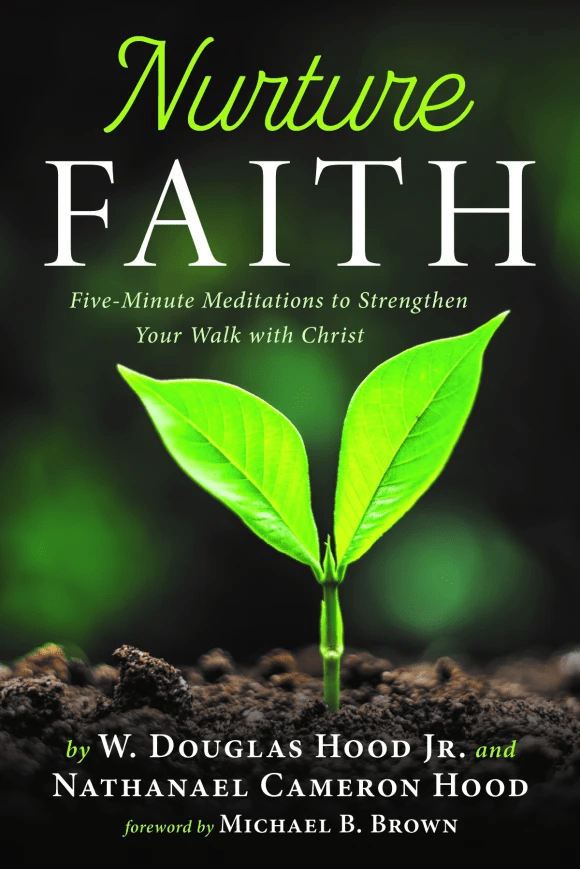
Any royalties received support the ministry and mission of First Presbyterian Church of Delray Beach.


Categories
Religious

When Our Self-Worth Stumbles

“Dear friends, now we are God’s children.”

1 John 3:2 (Common English Bible)

A major challenge faced by most of us is a preoccupation with what other people think of us. Sensitivity to the opinions of our friends and our enemies may sway from one moment to the next. Yet it remains a constant consideration. Politicians are not the only ones who have an ear to the ground or eyes on the polls. The rumblings of popular sentiment about how we are perceived are always on our radar. We crave approval and shrink from disapproval. Our mood for days is often determined by favorable or unfavorable commentary on our character, ability, or accomplishments. We form a mental picture of ourselves through the comments and opinions of those in our orbit. Our self-worth hangs upon what others think of us. The gravitation pull of even the most trifling uncomplimentary remark can result in an emotional collapse.

There may be something of value in paying attention to what others are saying about us. We live in community with one another. We are responsible for one another. Every decision, every behavior impacts the larger community in which we live and work. Most of us want to positively impact our own little portion of the world. We cannot ignore what others may say about us, nor should we. Unfavorable responses that come in our direction may provide insight for a course reset. Negative feedback can be a catalyst for rethinking our approach, our approach to friendships, work colleagues, and family. As we move forward from this day, a constant factor in life is that our yesterday does not have to be our tomorrow. We have the capacity to reflect upon favorable and unfavorable feedback and make a change.

A more fundamental question that we ought to concern ourselves with is what we think of ourselves. That question is answered by our thoughts, habits, and how we deploy our natural talents and gifts in the service of others. We form a mental picture of ourselves through our education, experiences, and fortitude to delve into challenges regardless of the perceived obstacles—real or imagined. Each one of us has limits of knowledge and ability. Yet, with desire and determination, new limits can be put in place of old ones—knowledge and understanding, and ability continually stretched. That is the power and value of attitude. But no one can surpass the limits of one’s current self-image. The mental picture of ourselves either releases energy for continued growth or imprisons us within our present ability.

For people of faith, the Bible helps those whose self-image is stuck for those moments when self-worth stumbles. John, the beloved disciple of our Lord, reminds us that “we are God’s children.” We are unable to fully comprehend God and God’s work in our lives and in the world. We are unable to know “what we will be.” (1 John 3:2b) But John reminds us that the God who created the heavens and the earth, the God who raised Jesus from the dead, claims us as God’s own children. Recalling our glorious nature as God’s own child is enough to strengthen a self-image that is weakened by the judgments of others. There is a deep tendency today to become like what we imagine ourselves to be. The one who claims us ought to matter. Since we are claimed by God, shall we not dare to think well of our value and to live by the highest thoughts?

Joy,

Categories
Religious

The Puzzle of Prayer

We always thank God for all of you when we mention you constantly in our prayers.”

1 Thessalonians 1:2 (Common English Bible)

It is not unusual for someone to ask me, “Please pray for me.” Often my response is an invitation to immediate prayer. My desire is to take the request for prayer seriously. By praying with the person immediately, I wish to say that I care deeply about them and that I appreciate their confidence in the power of prayer. Recently, however, I have begun to question, “Just what do they expect from this prayer?” “Do they really believe my prayer to do any good?”

Naturally, the Bible has much to say about prayer. What is often unrealized is just how frequently the mention of prayer in the Bible is one of complaint. The palmists, the prophets, Job, and the apostle Paul, often questioned the value of prayer, sometimes rather bluntly! Listen to a portion of Psalm 88, “But I cry out to you, Lord! My prayer meets you first thing in the morning! Why do you reject my very being, Lord? Why do you hide your face from me?” (Ps 13, 14) It is clear that today’s church is not the first to question the usefulness of prayer.

It is important—and helpful—to note, however, that in each complaint that is uttered, there is present a fervent belief that something can be expected from prayer. Prayer is never given up on in the Bible, never dismissed as not of any use. What makes each of those who wrestle with prayer people of amazing stature is their absolute confidence in the power of prayer—the power to disrupt at any moment the ordinary with the extraordinary. Without reserve or embarrassment, each character in the Bible shared the same compulsion to pray.

I will freely share that I have no idea how prayer works. The question itself may be foolish simply because it strives to understand God. And someone once wisely declared that if we can ever grasp God, then we must go looking for another God. Any God we can understand with our finite minds is simply too small to save us. What I am confident of is that God was very active in the drama recorded in the Bible and continues to be just as involved in the unfolding drama of life today. And God invites us, repeatedly, to seek the inflowing of God’s grace through regular prayer. Refusal to pray—even when prayer was questioned—simply was not an option for the people of faith in the Bible.

Joy,

~ ~ ~ ~ ~ ~ ~ ~ ~ ~

This mediation is from Dr. Doug Hood’s upcoming book, A Month of Prayer: Five-Minute Meditations for a Deeper Experience of Prayer, featuring prayers by Dr. Leo S. Thorne.

Categories
Religious

Is Belief in a Personal God Possible?

For many, the most challenging part of faith is belief in a personal God. Membership in a local church usually requires “a profession of faith.” Often, this is little more than mental consent that there is a God. That same consent to God’s existence usually assumes that the individual intends to place themselves under God’s authority. Yet, what is often present in that “profession” is a sincere desire to know God personally, to experience a relationship with God in such a manner that in those hours of deepest need, we may personally address God and feel that we are heard and cared for. Harry Emerson Fosdick is helpful here, “No one achieves a vital, personal, Christian experience without a profound sense of need.”[1] But the question presses, is belief in a personal God possible?

One difficulty in experiencing a personal God today is the tendency of impersonal thinking and living. Anything sensory is found to be inferior to reason and intelligence. During my ministry in Texas a number of years ago, one individual criticized my preaching as too personal and too emotional. He was a medical doctor and sought sermons that would stretch his thinking, not move his heart. He was suspicious of preaching that stirred emotions. To think of God in personal terms, he argued, was unsophisticated. I suspect that the Sunday morning pews are filled with people who are in agreement.

But look at what Jesus does here for his disciples: Jesus takes the qualities of human parenting as a clue to understanding God; asks that we address God as Father. God is not an impersonal force that moves through the universe. God is a living being that knows us, loves us, and has a divine desire for our lives. Jesus draws from what is the best in our hearts to show us its higher ideal in God. Certainly, it is true that God has given us minds and expects that we should be growing in knowledge. But we cannot pursue God and fully know God without the heart. One of the basic convictions of our Christian faith is that a loving purpose directs the universe.

Moments confront each of us that demand more than a mere belief in the existence of God. They are moments of such great personal need that more study—more knowledge about God—fails to satisfy. A calm strength in the midst of life’s storms is possible only as God is known personally. The Christian lives not by a higher knowledge of God. The Christian lives by faith, prayer, love, and communion with God. When the soul cries out for a personal God, Jesus shows us the way. It is so simple we doubt its power. Get down on your knees, patiently silence all the voices in your mind, and then say, “Our Father, who is in Heaven.”

Joy,


[1] Harry Emerson Fosdick, Riverside Sermons, New York: Harper & Brothers, 1958, 168.

~~~~~~~~~~~~~~~~~~~~~~

This mediation is from Dr. Doug Hood’s upcoming book, A Month of Prayer: Five-Minute Meditations for a Deeper Experience of Prayer, featuring prayers by Dr. Leo S. Thorne.

Categories
Religious

Faithful Complaining

The following mediation was written by Nathanael Cameron Hood, MA, New York University; MDiv, Princeton Theological Seminary

“After the Lord had said these words to Job, he said to Eliphaz from Terman, ‘I am angry with you and your two friends because you haven’t spoken about me correctly as did my servant Job.’”

Job 42:7 (Common English Bible)

When I first went to grad school at New York University in the early 2010s, I became friends with an aspiring PhD student who didn’t have much regard for organized religion. He was a good man—a genius student and doting father with whom I could talk for hours about politics and art. But whenever the subject of faith arose, his entire mood would change. On good days he’d become tight-lipped and dismissive—on bad ones, he could become outright belligerent. Few such memories stick in my mind quite like one morning when he told me that he’d finished rereading the Book of Job and had decided that the God depicted within was one of the greatest villains in literary history. He snarled that he couldn’t believe anyone could worship a God who would inflict such suffering on such a good man, give him no satisfactory explanation why, and only restore his fortunes once he apologized for complaining.

Over a decade later, I still think about this conversation all the time—not because he offended me, but because I often find myself agreeing with him. The Book of Job is one of the most challenging texts in the entire Bible, inspiring passionate, puzzled, furious debate for literal millennia. Some scholars suggest it began life as an Israelite folk tale that tried to rationalize the existence of evil in God’s creation. As the centuries went by, bits and pieces were Frankensteined into the text until it resembled its current, seemingly chaotic form. One of their key bits of evidence is the book’s epilogue in the forty-second chapter where—after Job repents for rebuking God—God turns around and chastises Job’s assembled friends who’d spent dozens of chapters defending God’s goodness, declaring that Job was the only righteous one among them. The only way to explain such an abrupt 180° reversal, these scholars declare, was that different writers had meddled with the original story to help Job—and God—save face.

One would think my recent time in the scholarly trenches of seminary would see me agreeing with these arguments. But curiously, I’ve found the opposite to be true. I wonder if these researchers are missing the forest for the trees, failing to grasp that within the larger biblical story of God revealing Godself to humanity it really was Job who proved himself the most faithful because of his willingness to challenge God. Consider Job’s friends—the quick-witted Eliphaz, the accusatory Bildad, the cutting Zophar, the impetuous Elihu. In their rush to defend God from Job they ended up reducing God into a static set of rules to be blindly followed. Ah, but our God is much more than this! Though God desires our obedience, what God wants more than anything else is a personal relationship with each of us. This is why God came to earth as a human being—to live with us, to celebrate with us, to cry and suffer and ultimately die with us.

All throughout the Bible we see righteous men and women struggle with God, refusing to be silent in the face of perceived injustice and evil: Jeremiah cursing God for dooming Jerusalem, the Psalmist despairing of God’s absence, the writer of Ecclesiastes dismissing all creation as meaningless. Even Jesus challenged God at Gethsemane, begging his father to save him from the suffering that was to come on the cross. In a way, it takes more faith to assume that God will hear and respond to our complaints and petitions than to blindly accept our suffering and misfortunes as God’s will. To think otherwise would diminish God, just as Job’s friends did in the strange, infuriating, and ultimately beautiful Book of Job.

Joy,

~~~~~~~~~~~~~~~~~~~~~~

To read more meditations by Dr. Doug Hood and Nathanael Cameron Hood, you can purchase Nurture Faith: Five Minute Meditations to Strengthen Your Walk with Christ from your favorite book seller.

Any royalties received support the ministry and mission of First Presbyterian Church of Delray Beach.

Categories
Religious

Called by Name

The following mediation was written by Nathanael Cameron Hood, MA, New York University; MDiv, Princeton Theological Seminary

“But now, says the Lord—the one who created you, Jacob, the one who formed you, Israel: Don’t fear, for I have redeemed yo; I have called you by name; you are mine.”

Isaiah 43:1 (Common English Bible)

It was a hot summer day in July 2006 when U.S. Air Force military chaplain Lt. Col. Brian Bohlman first reported for duty at the Landstuhl Regional Medical Center (LRMC) in Germany. As the largest American hospital outside the United States, it became the epicenter for treating American, NATO, and other allied soldiers critically wounded during the War on Terror. Though tired and slightly jetlagged, Chaplain Bohlman was immediately thrown into the deep end of military chaplaincy when, during his initial tour of the hospital, he was alerted that a bus of wounded soldiers would be arriving at the ER in half an hour. Many were in critical condition after receiving catastrophic “blast and burn injuries” from IEDs. Indeed, Chaplain Bohlman recounts how some arrived attached to life-support equipment that literally weighed hundreds of pounds. Though separated by an ocean from active combat zones, right then, Chaplain Bohlman found himself face-to-face with the very worst realities of war.

Military chaplains have served as part of the United States Armed Forces since the Revolutionary War, and though their duties have evolved over the years, they’ve traditionally had certain privileges unique to them. It was on that hot day in July that Chaplain Bohlman discovered one such exception to standard military etiquette when he was informed by his superior that upon arrival, each patient would be introduced to him in turn not by their rank and last name, but by their first name—just their first name. He recalls meeting his first patient and being told by an attending sergeant that his name was John. Looking down on the stretcher, the scared, scarred soldier grabbed his hand and wouldn’t let go. “John, welcome to Germany,” Chaplain Bohlman soothed, “you’re safe now, and we’re here to take good care of you.” In that moment, the two were no longer chaplain and soldier—they were just Brian and John, two human beings under the care of God.[1]

There’s a simple power in names, one reflected all throughout the Bible. In the Ancient Near East where the Hebrew Bible was first written and compiled, names were more than just labels—they were “symbols, magical keys…to the nature and essence of the given being or thing.”[2] Put simply, your name wasn’t just what people called you—your name was who and what you were. Many of the most dramatic moments in Scripture are moments of naming and re-naming as they mark some of the most intimate encounters between humanity and the divine: Abram becoming Abraham, the father of nations; Saul becoming Paul, the great evangelist; the Annunciation when Gabriel told Mary that she would bear a son named Immanuel, meaning “God is with us.”

The forty-third chapter of Isaiah contains another such example of the power of names. Written during a time when Jerusalem had been destroyed, and its people carried off to exile in Babylon, many of the survivors were given new names by their conquerors. Ah! But in this first verse God strikes down these new names, reminding them who created and formed them, that “I have called you by name; you are mine!” I wonder how many people in our modern society in the millennia after Isaiah was written similarly labor under false names: immigrants forced to adopt easy-to-pronounce English names for fear of ostracization; workaholics who disappear into their jobs and job titles; persecuted minorities debased by racial and ethnic slurs. How wonderful, then, that ours is a God who sees through these things and calls us by our names. Our true names that reflect our true, inner selves. The ones given to us at our birth, the ones no foreign power like Babylon, the ones no military pretension or IEDs, can change or take from us. Praise be to our God and the names God has named us! Israel. Emmanuel. Brian. John.

Joy,


[1] Bohlman, Brian. “Voices from the Field: Ready on the Ground: A Military Chaplain’s Reflection on Wounded Warrior Ministry at Landstuhl Regional Medical Center, Germany.” Essay. In Chaplaincy and Spiritual Care in the Twenty-First Century: An Introduction, edited by Wendy Cadge and Shelly Rambo. Chapel Hill, NC: The University of North Carolina Press, 2022, 62-64.

[2] Speiser, E. A. The Anchor Bible – Genesis. Garden City, NY: Doubleday & Company, Inc., 1964, 16.

~~~~~~~~~~~~~~~~~~~~~~

To read more meditations by Dr. Doug Hood and Nathanael Cameron Hood, you can purchase Nurture Faith: Five Minute Meditations to Strengthen Your Walk with Christ from your favorite book seller.

Any royalties received support the ministry and mission of First Presbyterian Church of Delray Beach.

Categories
Religious

When the Door Remains Closed

“Meanwhile, Peter remained outside, knocking at the gate.”

Acts 12:16a Common English Bible

Here is a story for everyone; a story of someone who tried and failed, but refused to give up. Peter was one of Jesus’ disciples. At a critical hour, he failed Jesus by denying him three times. But Jesus never failed Peter. Following Jesus’ resurrection, his continued embrace and love for Peter launched Peter into a preaching ministry of considerable zeal and devotion. Up and down the countryside, Peter gave witness to the power of the risen Christ to change lives. Peter’s primary exhibit for his testimony was his own life. Soon he found himself enmeshed by hostile forces and, finally, preached himself into prison.

Prayers were made for Peter by the Christian communities that he started and were now growing, as a result of his preaching. One night an angel came to Peter, placed the prison guard into a deep sleep, released the chains from Peter’s hands, and opened the prison doors. An important detail of this miracle story is that the angel instructed Peter to place on his sandals. The angel was able to place the guard into a slumber, release Peter’s hands from the chains that held him, and open the prison doors. Yet, the angel holds Peter responsible for placing on his own shoes. Apparent in this small detail is that God will always do what we cannot do, but God will not do for us what we can do. Peter was capable of placing upon his feet his shoes.

Peter, now freed from prison, goes out into the dark, hiding in the thickness of the night from Roman soldiers, and makes his way to a home where he hoped to be received and cared for. When Peter knocked at the outer gate, a female servant went to answer. Recognizing Peter, and overcome with surprise and joy, the servant runs back into the house with the grand announcement of Peter’s release. Yet, in her amazement and delight, she forgets to open the gate and let Peter into the residence. “Meanwhile, Peter remained outside, knocking at the gate.”

Peter does not shrug his shoulders and walk back into the night, commenting, “It’s no use.” Peter continues to knock. Peter is resilient. He will not give in or give up. Through his persistence, Peter reveals the grandeur of his trust in God’s continuing presence and care. Many of us will stand—at some moment in our life—before a closed door. The closed-door may be a job opportunity that never materializes, a romantic relationship that is never found, or an illness that lingers—health seemly more and more elusive. Before that closed door, life asks, “Will you continue to trust God in the face of bitterness and disappointment?” Peter stands before a closed-door unafraid, determined to see it through. His strength is located in God’s fidelity, demonstrated in his past. That same strength is available to us when we stand before a door that is closed.

Joy,

~ ~ ~ ~ ~ ~ ~ ~ ~ ~ ~ ~ ~ ~ ~ ~ ~ ~ ~ ~

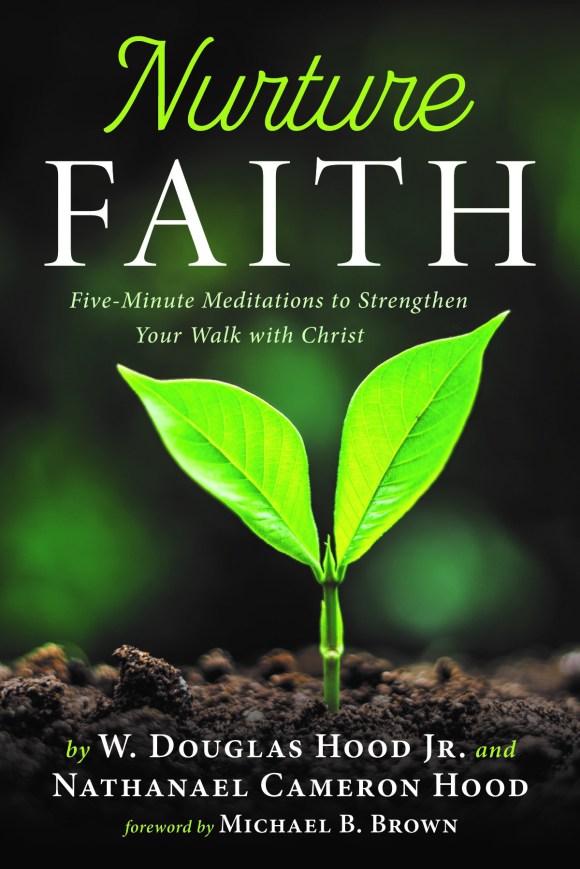
To read more meditations by Dr. Doug Hood, you can purchase

Nurture Faith: Five-Minute Meditations to Strengthen Your Walk with Christ

from Amazon or your favorite online retailer.

Any royalties received support the mission and ministry of

First Presbyterian Church of Delray Beach.
Categories
Religious

Difficulties With Prayer

“In the same way, the Spirit comes to help our weakness. We don’t know what we should pray, but the Spirit himself pleads our case with unexpressed groans.”

Romans 8:26 (Common English Bible)

A parishioner in a former congregation talks about her struggle with prayer this way, “I have absolutely no idea what I am doing!” It is a common refrain I have heard in my thirty-six years of ministry. What I once assumed would be one of the most accessible practices of the Christian faith is, in fact, among the most difficult. Those who are honest, those who are unafraid to express the vulnerabilities of their faith, speak to me of their difficulties with prayer. I always begin by affirming how delighted I am to hear that! If anyone is experiencing difficulties with prayer, what they are telling me is that they are wrestling with it rather than abandoning prayer to the professional clergy. There are three difficulties that are spoken of most, and identifying them helps in understanding this teaching from Romans.

The first difficulty that is mentioned is, perhaps, the one that requires the most courage to confess: the absence of appetite! Simply, there are people who have no driving hunger for going to their knees or closing their eyes to speak to God. We understand them when we contrast this lack of appetite with the strength of other appetites, such as that for good food, or the enjoyment of rare and expensive beverages, or the pursuit of some interest, such as golf. A genuine appetite has about it a mighty dynamic that requires little discipline. When they turn to pray, it is often out of a perceived compulsion; a requirement to be a “good” Christian. More time is spent in guilt for the lack of enthusiasm for prayer than the practice. The duty of prayer becomes oppressive.

A second difficulty that is heard is a weakness of faith. Questions fill the mind and heart about the effectiveness of prayer. This is particularly true after prayer has been reduced to “asking” God for something. Though Jesus does encourage us to ask for anything that we might need, Jesus also demonstrates in his own life a richer dynamic of prayer—simply enjoying a relationship with God. That relationship is identical to one we may have with a spouse or a friend. We gather simply to enjoy one another, to share joys and struggles with each other. When prayer is limited to requests, it is easy to dismiss prayer when there isn’t a pressing need. God is dispensable. Absent is any notion that we are turning to God in the quiet assurance that we are drawing near to one who cares for us deeply.

Finally, the difficulty of knowing what to pray for generates hesitancy. Many days present problems and challenges to which we see no solution. In a critical moment, we are unable to discern which direction to take or course of action to pursue. We are stumped and are unable to fashion a reasonable request before God. It is here that we require wisdom that is from another source—a power beyond our capacity. These three difficulties open us to hear the gracious promise presented here in Romans: “the Spirit comes to help our weakness.” The Holy Spirit clarifies and strengthens our prayers. Additionally, prayers that may be short-sighted or are made without an understanding of God’s work are corrected. The Holy Spirit intercedes for us, and feeble efforts to pray become sufficient before God.

Joy,

~ ~ ~ ~ ~ ~ ~ ~ ~ ~ ~ ~ ~ ~ ~ ~ ~ ~ ~ ~

To read more meditations by Dr. Doug Hood, you can purchase

Nurture Faith: Five-Minute Meditations to Strengthen Your Walk with Christ

from Amazon or your favorite online retailer.

Any royalties received support the mission and ministry of

First Presbyterian Church of Delray Beach.

Categories
Religious

The Great Wisdom of Prayer

“Early in the morning, well before sunrise, Jesus rose and went to a deserted place where he could be alone in prayer.”

Mark 1:35 (Common English Bible)

It was said of the disciples long ago that people held them in wonder and awe that they had been with Jesus. To be with one of the disciples was to experience one degree of separation from our Lord. That close proximity to Christ resulted in an experience of spiritual vitality and power. God’s love, wisdom, and strength were no longer limited to one’s imagination as stories of Jesus’ life and ministry were shared. In the company of a disciple—or disciples—God’s presence seemed to come near. The vision of God’s glory grew more expansive in the heart as a result of being in the presence of one of the disciples. Perhaps that same fascination is what drives each of us to be photographed with those we admire. There is an unmistakable attraction and thrill to standing in the presence of those who have acquired a larger-than-life persona.

In this passage from Mark’s Gospel, Jesus had just finished a hard, grueling day. A similar day would follow. How could he be ready for it? What would be the spring of fresh physical, emotional, and spiritual strength from which he would drink? Mark gives us the answer and with it the key to Jesus’ vitality and stamina, “Early in the morning, well before sunrise, Jesus rose and went to a deserted place where he could be alone in prayer.” This one verse suggests the great wisdom of prayer: Every morning, draw from the inexhaustible power of God by drawing near to God’s presence. That is done in prayer. Once when a man was asked what he was doing each day sitting alone in a church, gazing upon a picture of Jesus, he answered, “I am simply looking at him and he is looking at me.” Prayer is time with God.

The weakest, humblest life can be made stronger when placed before God. As we pray, the Bible promises that God will be there. There will be days when God seems absent. The Psalms tell us this. Pray anyway. Know that God is present. Day after day the eyes of the soul become more sensitive to God, the heart more aware of God’s still small voice speaking. Eventually, prayer becomes that daily practice by which the individual soul becomes intertwined with the presence and strength of God. The fact of intimate communion with God is the great reality of true, regular prayer. In prayer, we come to see ourselves surrounded by God’s love and concern for us as we begin each new day.

How strange, how foolish it must seem to God that we should be content with so little prayer. This particular occasion, mentioned in this one verse of Scripture from Mark’s Gospel, was no unusual occurrence for Jesus. Jesus prayed often; Jesus prayed for himself and for others. Jesus took time for prayer before each day and before every difficult challenge that drew near to him. Jesus teaches prayer to us by example, for he knew from his own experience that prayer was a vital part of navigating the inevitable difficulties that each one of us must face. Today, many Christians are troubled by weakness, doubt, and fear, largely because they miss the help that prayer might provide. The greater wisdom of prayer is simply discovering—and experiencing—that we never have to face a day alone.

Joy,

Categories
Religious

A Real and Vital Faith

“Happy are people who have pure hearts, because they will see God.”

Matthew 5:8 (Common English Bible)

Jesus teaches, “Happy are people who have pure hearts, because they will see God.” The “pure heart” is a faith that is “backed up by convictions, whose outward deeds match their inner commitments.”i  What Jesus is saying is that those who have “pure hearts” will have a faith that is real and vital. It is a faith experienced in the deep recesses of the heart, a faith that influences every moment of our lives. Such a faith confronts the God of the Holy Bible as an inescapable reality. Vagueness and doubt dissipates, senses become alert as though biting into something hot and spicy, and confidently we know that God is right in the midst of the present moment. 

This is not a faith that simply believes in God or has opinions about God. The church has multitudes of people who do that. It is one thing to recite the creeds of the church and utter words of belief, as almost all of us do. It is quite another thing to say, “God is in this place! I feel God’s presence.” That experience is like taking notice of a beautiful piece of art, imagination stirred by the rich use of colors or the complexity of brush strokes or standing on a beach watching a sunrise as if you had never seen one before. No one argues with a beautiful piece of art or with a sunrise. It is simply experienced.

The critical difference is awareness. Consider a conversation I had some years ago in Pasadena, California. During my graduate studies there, I commented to a resident what a joy it is to wake each morning, pour a cup of coffee, and enjoy the beautiful mountain range. At that comment, my friend looked-up at the mountains, with no discernable emotion, and said, “After living here for a while, you no longer notice them.” My friend acknowledged the presence of the mountains but they were not real to him. He had lost his capacity to notice them and have them move him deeply by the beauty that they generously shared day after day. His heart was not pure. Rather, his heart, muddied by the multitude of the small and large things that occupied his thoughts, fell numb.

Anything real to us results in emotional vividness. If such emotion is absent, we may question if we are paying attention, eyes wide open expecting the unexpected and anticipating wonder. Belief can be a profound matter, even courageous when such statement of belief may result in marginalization or persecution. However, often our beliefs lie at the surface of our lives, very present but lacking any meaningful impact on us. Perhaps attention to responsibility, to fulfilling daily tasks, or simply cynicism and exhaustion of the daily grind has narrowed our focus. Experiencing the uncommon in the ordinary requires a pure heart, that is, a heart released on occasion from the urgent tasks always before us, and open to the nuances of the present moment. It is what the Bible speaks of as stillness before God. Such a heart sees God in a child playing, in nature, in ordinary situations, and in opportunities to be useful to others. 

Joy,

_________________________

i Thomas G. Long, Matthew, (Louisville, Kentucky: Westminster John Knox Press, 1997) 50.