Categories
Religious

Guilt and Forgiveness

The following meditation was written by Rev. Dr. Michael B. Brown, Pastor of Blowing Rock Methodist Church in North Carolina.

“You will love your neighbor as yourself.” Mark 12:31 (Common English Bible)

At a lovely gift shop in Banner Elk, North Carolina, I saw a needlepoint plaque containing these words: “I said, ‘Lord, forgive me.’ He answered, ‘I will if you will’.”

When a teacher of the Mosaic Law asked Jesus what commandment was the most crucial, Jesus replied that loving God was first, and that loving one’s neighbor as one’s self was next in line. “You will love your neighbor as yourself.” Without changing a single word in that second commandment, but simply by rearranging them, it becomes clear that self-love is a biblical command. Not self-absorption. Not arrogance. Not conceit. Not “my way or the highway.” Nowhere in scripture are we told that our lives are to take precedence over others who are also created in God’s image and by God’s love. However, neither are we told that we are less important than anyone else. In fact, we are clearly commanded to appropriately love ourselves. Respect ourselves. Care for ourselves. And that involves, in fact, requires that we forgive ourselves.

“The tension between the harsh super-ego and the ego that is subjected to it is what we call the sense of guilt; it expresses itself as a need for punishment.”[1] In those words, Freud articulated the destructive power of unresolved guilt—“a need for punishment.” I have long believed that guilt can serve only one of two purposes. It is either (a) a classroom or (b) a prison cell. It either teaches us how to live with meaning, dignity, and compassion, or it imprisons us to such an extent that the discovery of meaning, joy, and peace is impossible.

Think of a person who cheated on an exam in college and, thirty years later, still castigates himself for having done so. Think of the woman who spoke a harsh word to an acquaintance who is now deceased. She cannot retrieve the moment. There is no way to make amends. And so she lives with an unresolved gnawing self-recrimination that never goes away. Think of the spouse who was once unfaithful and, though forgiven by husband or wife, never feels worthy of that forgiveness or love. Those people limp their way through life, burdened by a memory of failure. That is guilt as a prison cell. Contrast that to the biblical model of self-love. That model interprets past actions as lessons to be learned for future successes. The dishonest student learns that no one can effectively cheat their way through life. There are no shortcuts as professionals, spouses, or parents. The person who spoke harshly realizes the power of words and, thus, develops into one who uses words to lift up rather than tear down. The unfaithful spouse recognizes the cherished status of marriage and commits him or herself to making the most of a second chance. That is guilt as a classroom.

Once the lessons guilt has to teach have been learned, our faith says we are challenged to let it go and move on. Lay it at the foot of the Cross and move forward. That’s what grace is about. It is about accepting the gift of a joyful future that God offers free of charge. Doing so requires appropriate self-love (i.e., forgiving yourself). The Christian doctrine of Atonement teaches that Jesus took our guilt to the Cross on our behalf. To insist on retaining that guilt diminishes the sacrifice of love he made for us. “I said, ‘Lord, forgive me.’ He answered, ‘I will if you will’.”

Joy,


[1] Freud, Sigmond. Civilization and Its Discontents (1930), trans. James Strachey (New York: W. W. Norton, 1961), p. 84

Categories
Religious

A Mother’s Arms

The following meditation was written by Rev. Dr. Michael B. Brown, Pastor of Blowing Rock Methodist Church in North Carolina.

“‘Jerusalem, Jerusalem . . . how often I have wanted to gather your people just as a hen gathers her chicks under her wings.’” Luke 13:34b (Common English Bible)

My first bicycle was a red Schwinn. No gears. No hand brakes. But it was a thing of beauty to a little boy on his seventh birthday. Our family lived in a house with a long driveway going downhill to the street below. Across the street was an undeveloped piece of property, separated from the road by a deep ditch.

I had learned to ride a bike (or, so I thought) by pedaling around on one that belonged to my cousin. His parents restricted us to their driveway, which was paved and flat. In that safe confinement, you couldn’t build up much speed, nor did you have trouble applying the brakes. When my parents gave me the new Schwinn, it could just as well have been a Lamborghini to me. It was the most beautiful vehicle I had ever seen. As I hopped on, my dad told me to stay on the flat area of the driveway next to the house. But, where’s the adventure in that? I was a competent cyclist, a master of the two-wheeled beauty. So, ignoring wise advice, I turned and headed down the hill toward the street below. That’s when I realized that braking on a flat surface at a slow speed was an entirely different thing than braking on a steep decline at an accelerated speed. It was many years ago, but I still remember the mix of adrenaline and fear as I rocketed toward the street below, wondering why the brakes didn’t seem to be having much effect. Thank God there happened to be no traffic!

Off the driveway I went, into and across the street, and then airborne for just a moment until my new bike and I came to an inglorious halt in the ditch on the other side of the road. My parents had come running behind me. Dad lifted the bicycle from the ditch while mom lifted me. Neither the bike nor the rider suffered any serious injury. I was more embarrassed than harmed. I do remember that the scolding I expected did not occur. Instead, my mother lifted me into her arms and held me as I cried. I was safe. Forgiven. Loved. She gathered me into her love “just as a hen gathers her chicks under her wings.”

Jesus used that maternal language to describe the emotions he felt for Jerusalem and all that it symbolized. He was a rabbi. He knew that the Holy City was a living and visible reminder of the life and history of Israel. Somehow, within it lived the whole story of “God’s chosen people”[1], its journeys and trials, its previous exiles into foreign lands and its current occupation by a foreign captor, the legacies of its kings and prophets, its poetry of faith contained in the Psalms, its sincere but often failed efforts to honor the Law of Moses, its hopes and dreams and sorrows and tears. Jesus loved that history, he loved those people, as a mother does who gathers her child into her arms and sympathizes and comforts.

All of life’s surfaces are not smooth, flat, and easy to navigate. There are downhill slopes that we feel incapable of traversing. Frightening experiences or alarming crises occur, increasing in speed and intensity, and we have no brakes to slow them down. Sometimes, like the victim in The Parable of the Good Samaritan (Luke 10:25-37), we find ourselves feeling bruised, bleeding, and beaten in one of life’s ditches. It is then, Jesus promised, that he comes to us, that he is with us, that he gives us strength not our own to survive the moment, and that, like a loving parent, he holds us close until the pain has passed. Kyrie Eleieson, we pray. “Lord have mercy.” And he gathers us into his healing arms.

Joy,


[1] References to the theme of the selection of Israel and of the New Testament Church for a special and intimate relationship with God can be found in Deuteronomy 7:6; 1 Peter 2:9

Categories
Religious

A Working Title

The following meditation was written by Grace Cameron Hood, Director of Children and Family Ministry at First Presbyterian Church of Delray Beach

“Now we see a reflection in a mirror; then we will see face-to-face. Now I know partially, but then I will know completely in the same way that I have been completely known. Now faith, hope, and love remain—these three things—and the greatest of these is love.” 1 Corinthians 13:9

Many films and books in process of being produced do not have a final title. Until the film/book is done and the content is really completed, a title might change. Titles usually reflect the contents, but might not be understood by the audience. An example would be Harry Potter and the Sorcerer’s Stone, or as our English friends would call it, Harry Potter and the Philosopher’s Stone. I would imagine that the name was changed because American children would not know what a philosopher was and would find that title too boring. 1984 by George Orwell started as The Last Man in Europe. Margaret Mitchell tried out a number of names before settling on Gone with the Wind. An example of a well-known movie title change would be Toy Story, which was originally called You Are a Toy! Another example is Scream, which started as Scary Movie. Scream or Scary Story would be an apt description of the content of this movie.

Imagine if our lives had a “Working Title” that described the content of our lives. Every season of our lives, every experience would change the title. Some of the titles might be:

Safe in Mommy’s Arms

I Broke My Right Arm and Can’t Ride my Bike With my Friends

My life is Over as I Just Broke Up With my Boyfriend

Graduated From High School and Got into my College of Choice

Didn’t Get the Job I Wanted

Went Out Drinking with Friends and Lost myself for Several Years

Had a Baby

Had a Teenager

Have Aging Parents

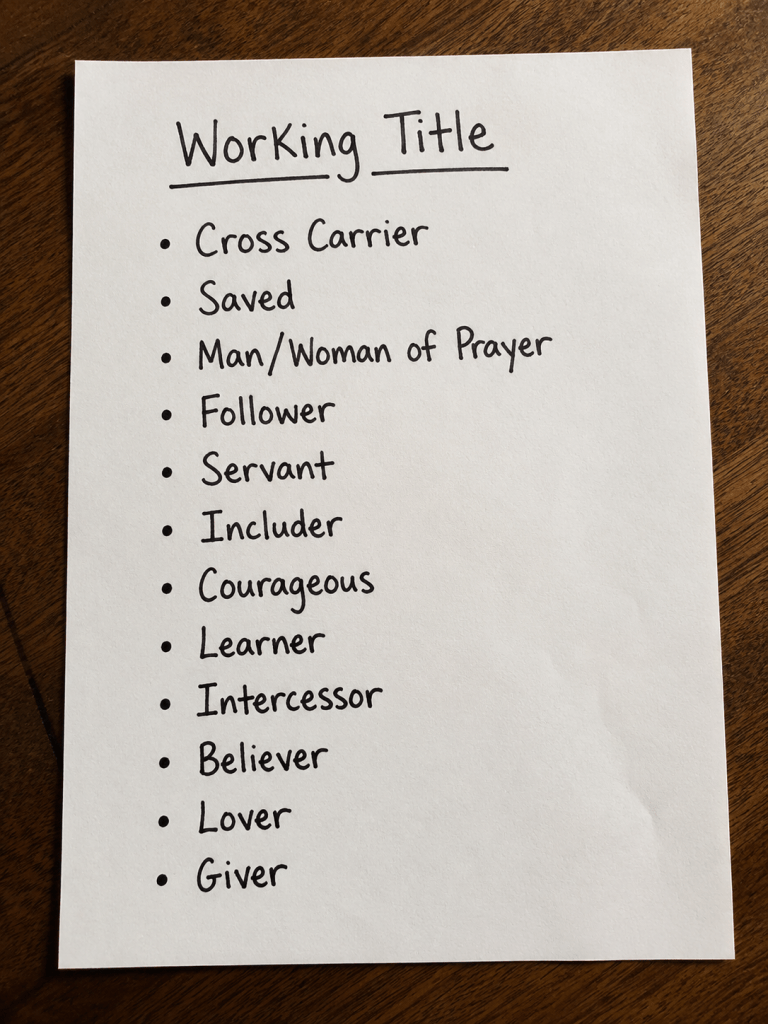
There are so many titles to describe our life. In the midst of all the angst, thrills, and monotony of our lives, God steps in to help us understand our true “Working Title”:

Cross Carrier

Saved

Man/Woman of Prayer

Follower

Servant

Includer

Courageous

Learner

Intercessor

Believer

Lover

Giver

The list goes on. Each title describes who we are and maybe even alludes to what we should be doing. It is through our devotional life of immersing ourselves in the Scriptures and communing with God through prayer that we come to understand who we truly are and what we are called to do. Barbara Brown Taylor, in her book Always a Guest, describes the journey of what our “Working Title” could be in her address to Millbrook Baptist Church entitled “How to Lose Your Life Every Day.” Maybe we should be called “Losers” as we turn our lives around, lose ourselves, and live by some very easy and simple guidelines. Be genuine, serve others, be humble, put others first, honor and encourage others, hate what is evil, work hard, be joyful, patient in troubles, pray always . . . [1]Stop! Too much! Does this list reflect the life we are living? Is this the content of our lives? Which actions take us from “Working Title” to “Final Title?” It is clear that immersing ourselves in a relationship with God centered in prayer, worship, the Bible, and service are some of the actions that develop the plot of our lives.

The wonderful thing about our relationship with God is that we are living with a “Working Title”. 1 Cor. 13:12 reminds us that our journey is a dim representation of our whole, an incomplete version of who we are. These words of hope spur us on to love more fully, give more deeply, pray more fervently, serve more joyfully. What we do now is indeed a “Working Title.” Our “Final Title” will be Good and Faithful Servant.

Joy,


[1] Taylor, Barbara Brown, “Always a Guest”, Westminster John Knox Press, Louisville, Kentucky, 2020, Pages 61-69

Categories
Religious

God is Great …

The following meditation was written by Grace Cameron Hood, Director of Children and Family Ministry at First Presbyterian Church of Delray Beach.

“One of the disciples said, ‘Lord, teach us to pray . . .’ Jesus told them, ‘When you pray say: “Our Father . . .”’” Luke 11:1b-2a

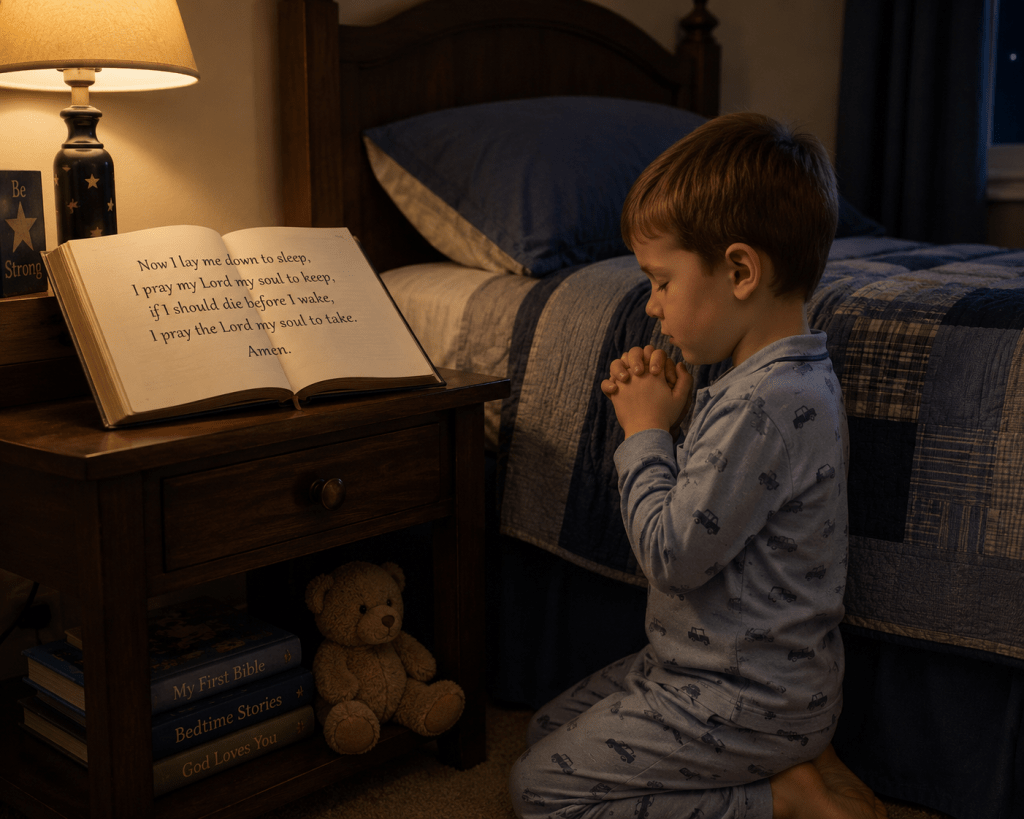
Now I lay me down to sleep, I pray the Lord my soul to keep, if I should die before I wake, I pray the Lord my soul to take. Amen.”[1]

This is one of the first prayers most children have learned. The origin is thought to be the New England Primer around 1737. I know that there must be so many reasons endemic to that time that called attention to the small child that they might die during the night. To our ears, it is horrible. To the point that the prayer has been greatly edited by teachers, parents, and educators.  Now we pray, Angels watch me through the night and wake me with the morning light.” We are all so relieved by this nicer ending.

Another first 18th century prayer children learn is:

God is great, God is good, and we thank him for our food. By his hands we are fed. Give us, Lord, our daily bread. Amen.[2]

These two prayers that were and are prevalent in many Christian households here in the USA, are teaching tools for children. They give a place for children as they are growing Christians to begin a habit of prayer at mealtime and at bedtime. They both draw attention to God as the giver of life and the sustainer of our souls. They focus on the times of the day when the body is nourished either by food or sleep. These two well-known prayers are starting points for a life centered on prayer. 

A third prayer recited in every Christian Church around the world is “The Lord’s Prayer.” This prayer started with a disciple asking Jesus how to pray. Interestingly enough, all of these disciples were surrounded by people praying. In the Jewish tradition, prayer was everywhere. The disciples must have seen something different in the way that Jesus prayed. Jesus responded in very simple language. Just as a child learns “God is great . . .”  the early Christians learned “Our Father . . .”  Jesus focused on a short, powerful prayer done with simple words and easy ideas.

Down through the ages, The Great Prayer has been edited, translated into every language imaginable, and prayed from every corner of the globe. Each faith tradition has different wording. Do we ask God to forgive our debts, sins, or trespasses? The ending has also been wrapped up nicely with “For Thine is the Kingdom . . ,” Different words, but the same meaning. One only has to start, “Our Father . . .”, and the world quiets and listens.

I am reminded of when the children were young. For a while our custom was to go to McDonalds after church for lunch. Rachael and Nathanael would go play in the playground while I saved a table and Doug ordered the food. One Sunday, as the children were ushered back from the play area and hands were washed, we finally sat down. Everyone fixed their area . . . opened the Happy Meal boxes, checked out the toys, spread out the burger wrappers, and divvied out the ketchup cups. Then, in a loud preacher’s voice, Nathanael said, “Let us pray.” This got the attention of the whole restaurant. He began, “God is great . . .” The entire restaurant finished the prayer . . . we all knew it. We had all grown up with it. It came back in an instant.

Our Christian walk with God begins somewhere. It might begin with a simple prayer at the bedside or at a table that our well-meaning grandparents and parents helped us learn. Jesus has given us words to talk to God that allow for growth. The disciples took these words and used them to power their lives and witness. They took this prayer around the known world and taught people how to talk to God. Now, we are led to also kneel and receive power to share the love of God to a hungry and sleepy world.

Joy,


[1] Anonymous

[2] Anonymous