The following meditation was written by Rev. Susan Sparks, senior minister at Madison Avenue Baptist Church (American Baptist) in New York City.
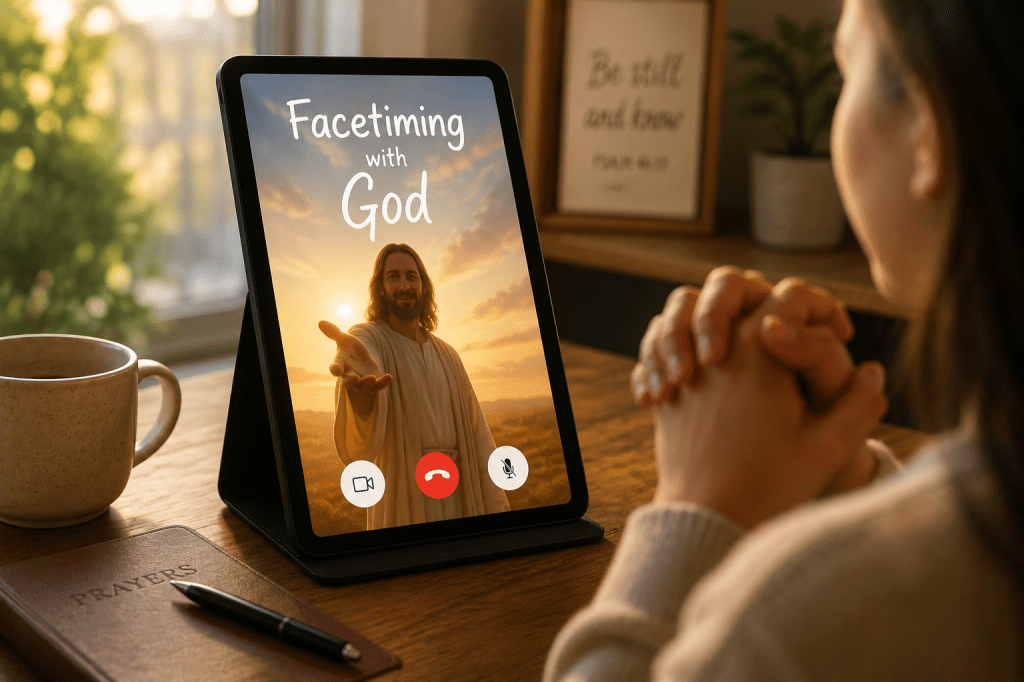
Recently, I got to wondering what it would be like to FaceTime God. You know, like when we FaceTime our friends or family with a real-time video image on our smartphones. If we did this with God, who would we see?
In a way, prayer is like FaceTime. We bow our heads or close our eyes, ring God up, and perhaps an image pops into our mind.
Growing up, I was pretty clear that God looked like an old-timey western gunslinger. Clint Eastwood in High Plains Drifter, maybe? And why not? The scriptures I remember hearing were ones like Deuteronomy 28:22: “The Lord shall smite thee with consumption, and with a fever, and with an inflammation, and with an extreme burning, and with the sword, and with blasting, and with mildew; and they shall pursue thee until thou perish.”
Yup. High Plains Drifter.
And the images I was exposed to in church didn’t help. Every Sunday, this scary judgmental God stared back at me from the stained-glass windows surrounding our pew. On the right-hand side near the front was a depiction of God drowning Pharaoh’s army in the Red Sea. On the left-hand side was a very unhappy Jesus hanging on a cross. The window in the back had God destroying the world with a flood. This was not a God you wanted to annoy.
Think about your own upbringing. What holy images did you learn to see? What do you see now? Is God male or female? Black or white? How old is God? If God talks back, what does God sound like? Does God speak English or Spanish or Farsi? What is God wearing? What is God doing while you pray? Reclining in a chair or a throne? Taking notes or staring out the window?
None of us is born with a genetic code or microchip that has “the” image of God. From birth on, we gather information from sources such as our families, our religious upbringing, and our culture to construct our own personal view of God.
Why does this matter? Because the image of God we use in prayer drives how we engage with God.
For example, most of our liturgy today is couched in male language—specifically, father language. This is not necessarily a problem unless it is the only language we use. When God is father, we tend to project all the parental baggage around that term onto God. And if God is mother, we do the same.
Think of how you communicated with your mother versus your father. There were probably things you felt more comfortable telling one than the other. One parent may have encouraged more of a “yes,” “no,” or “maybe” interaction, and the other an intimate conversation for hours. Thus, our prayers may be very different based on which image we use.
And that’s just gender. What if you imagine God as a young person versus an old person? Or as someone of a different race or culture? What if you imagine God as someone who smiles and laughs? Or as someone who cries with you during prayer?
We all know that God is beyond titles or descriptions. But it is human nature to want to imagine or “see” God during prayer. As you pray and “FaceTime” God this week, try to open yourself up to new images of God you haven’t considered. You may well discover a level of intimacy and honesty you didn’t know was possible.
The following meditation was written by Dr. Thomas K. Tewell, retired pastor and founder of Macedonian Ministry Foundation.
If you had to spell the word PRAYER from your own experience, how would you spell it?
Some people spell prayer P-R-E-S-E-N-C-E, because they see prayer as a doorway into the presence of God. Others spell prayer R-E-L-A-T-I-O-N-S-H-I-P because they see prayer as a way of cultivating a dynamic relationship with the living God. There is not one right way to spell prayer!
But I spell prayer Y-I-E-L-D-I-N-G, because I see prayer as relinquishing my will to the greater will of God. I came to this understanding of prayer when, in my study of the New Testament, I learned that the only thing that Jesus’s disciples ever asked him to teach them was, “Lord, teach us how to pray.” After spending three years of their lives with him, the disciples did not ask Jesus to teach them to heal the sick, or to perform a miracle, or to use everyday stories to teach Godly truths. They did not ask him to teach them how to overcome fear. But the one thing they asked him to teach them was. “Lord, teach us how to pray!”
The disciples believed that prayer was Jesus’s power source. He prayed before he invited the disciples to follow him, and he prayed before he raised Lazarus from the dead. He prayed at all the major moments in his life . . . and he prayed early in the morning as the Gospels say, “was his custom.” After being with him for three years, the disciples realized that prayer was his lifeline and the anchor for his soul.
And the disciples remembered that in the Garden of Gethsemane outside Jerusalem, on the last night of his earthly life, he fervently prayed this prayer, “My Father, if it is possible, let this cup pass from me, yet not what I want, but what you want.”.[1] When Jesus asked God that he might be spared from the cross, he added but not my will but thine be done! Jesus yielded his personal will to God’s greater will. This is why I spell prayer Y-I-E-L-D-I-N-G. This is the essence of prayer. It is submitting my will to God for daily guidance so that I am open to focusing on God’s will and not simply my own desires.
This is why my daily prayer posture is that of open hands. Years ago, when I was praying intensely for something, I looked down. I saw that my hands were clenched in two fists. I felt God saying to me, “ Tewell . . . you are not open to me and my will. You are preventing me from giving you what I want to give you because you have closed your hands. You are not open to receiving my gifts. God had to pry open my hands over time, and I started to open my hands so that God could take things out of my hands that are blocking me from God . . . and God can put into my hands anything that God wants to give me. This prayer posture of open hands is a game changer!
When I open my hands to God, I start to see life from God’s wider perspective. As author Madeleine L’Engle wrote, “people have a point of view. God has view!”[2] From God’s wider perspective, I start to see that God has a bigger agenda for my life and the lives of others than I imagined. So, my job as a disciple of Jesus is to get my will in line with God’s greater will, and my limited agenda in tune with God’s wider agenda. This, as I see it, is the purpose of prayer. It is what I mean by Y-I-E-L-D-I-N-G to God! As this well-known quote, attributed to preacher Dr. Lloyd Ogilvie, pointed out, “the purpose of prayer is not to change God’s mind but to receive God’s mind.”
When we pray in the name of Jesus, we are asking Jesus to “sign his name to our prayer.” If there is anything in that prayer that is not in tune with God’s will, then we are asking Jesus to correct our thinking so that we are in tune with the greater will of God. This is an important part of Y-I-E-L-D-I-N-G to God’s greater will. Prayer is a mystery. God doesn’t answer prayer on our timetable or in accordance with our desires. Prayer is not something that is easily figured out. God has purposes for events and experiences in our lives that are greater than we can imagine. This is why we must constantly Y-I-E-L-D to God!
Prayer is a mystery. It is a reminder that God’s ways are bigger than our ways. Some years ago, a single parent in a congregation I served as pastor was struggling to make ends meet. His dream, and his ardent prayer, was to buy his son a bicycle at Christmastime. The man hoped that he would receive an end-of-the-year bonus from his company that would allow him to splurge on the bike that his son desperately wanted. About a month before Christmas, the single Dad was riding alone in an elevator in the office building when his boss got on. My friend asked his boss how the end of the year was looking and if he thought there might be an end-of-year bonus that year. Although the boss said that he could not promise anything, the firm was in the process of closing a big deal that would be finalized in a week. It might make the bonus the biggest that the company ever had! Wow! My friend, the single Dad, was ecstatic!
In his enthusiasm, the Dad went to the store that night to look for a boy’s bicycle for his son. As he entered the store, a group was outside collecting money for a local homeless ministry. The church I served also had a ministry to the homeless, so my friend gave a little extra to the homeless ministry. He filled out a card with his name, address, and phone number on it so the homeless ministry could thank him for his gift. Then he entered the store to shop for a bicycle, but he could not find one that he liked or could afford.
It was fortunate that he couldn’t find a bicycle that night. Several days later the boss announced that the contract had fallen through and . . . Alas . . . there would be no year-end bonus. That meant no bicycle for his son. My friend was crushed. He tried to think of any possible way to get a bicycle for his son that Christmas . . . but it seemed that there was no way!
On December 20, he got a phone call from that Homeless Ministry to which he donated money, indicating that he had won a raffle. My friend said that he never entered a raffle. But the Director of the Homeless Ministry corrected him and said that when he gave that contribution and signed a form, he had unknowingly entered a raffle . . . and he won a prize! When he asked the Director of the Homeless Ministry almost as a throwaway question . . . ” What is my prize?” the Director replied, “Your prize is a boy or a girl’s bicycle.”
God didn’t answer my friend’s prayer in a way that he would have expected! Prayer is a mystery! I don’t understand how prayer works . . . but I do understand this. That God loves us more than we can imagine. And that is why God doesn’t want any of us to miss the relationship and the presence of God that God offers us in prayer. So that is why in my own prayer life I am daily Y-I-E-L-D-I-N-G to God’s greater will . . . because I know that our God has more in store for us than we can ever imagine. And I don’t want anyone to miss knowing this God . . . the God revealed in Jesus Christ! Do you?
The following meditation was written by Rev. Dr. Michael B. Brown, Pastor of Blowing Rock Methodist Church in North Carolina.
“Remember the Sabbath day and treat it as holy.” Exodus 20:8 (Common English Bible)
I took driver’s education classes the summer after my 10th grade in high school, when I was just barely fifteen years old. I still remember a day when three of us students were in a car with the instructor, going through drills. It was one of the first times we had been allowed out of the high school parking lot and onto a public road. One student was behind the wheel, the instructor was in the passenger seat, and the other two of us were in the backseat. Somehow the student who was driving managed to stall the engine right in the middle of a busy intersection. Traffic was whizzing by left and right. Cars behind ours were ignoring the “Student Driver” bumper sticker and impatiently blowing their horns. But, the young man behind the wheel sat there as leisurely and calmly as if he were on a lounge chair at the beach. Very casually he reached into his back pocket, withdrew a handkerchief, blew his nose, folded the handkerchief carefully, and returned it to his pocket. The driving instructor, a high school basketball coach not known for being soft and fuzzy or particularly patient, looked like his head was going to explode. Finally, he yelled, “What are you doing?” (Being honest, the language he used was not nearly that polite.)
Looking back on that experience, I see a fair amount of comedy in it. However, I think there is also some wisdom if you look for it. Sometimes in the busy intersections of life, surrounded by fast-paced traffic on both sides and carrying weighty expectations from others, perhaps one of the best things we can do is simply to pause. To rest for a moment. To sit quietly as the world goes by, allowing ourselves simply to breathe. The fourth commandment to honor the Sabbath is an instruction to do just that. It is located right in the middle of the other nine Commandments, much like an intersection between dictums about honoring our behavioral covenant to God and honoring our behavioral responsibilities to people.
The Hebrew word is Shabbat (שַׁבָּת), which means a day (time) of rest and renewal. It isn’t about blue laws or what one can or cannot do on Sunday (or on Saturday, if you observe the Hebrew Sabbath). It was never about any of that. Shabbat is essentially about self-care, about pausing now and then to refuel and regenerate. No matter how exorbitant gasoline prices are as I write this meditation, the simple truth is that I have to pay them. If I do not refuel my automobile, it will eventually cease to move. That very same principle applies to us. All work and no play, no rest, no stillness, not only makes Jack a dull boy, but in time can make him a dysfunctional one.
I often advise people, “Whatever brings you joy and peace, as long as it’s moral and legal, do it . . . as much as you can . . . as often as you can. That will empower you to do all the other things the world expects (and often demands) of you.” “Self-care is never a selfish act,” wrote Palmer Parker. “It is simply good stewardship of the only gift I have, the gift I was put on earth to offer others.”[1] You cannot provide to those who need you that which you have denied yourself.
So, if it’s golf or Mah Jong, swimming or fishing, Pilates or Yoga, hiking or gardening, painting or playing music, reading a book or going to the movies, volunteering in a helping agency or attending church, wherever you find your place of peace, spend time there. And do it often. “Remember the Sabbath . . . and treat it as holy.” It is, in fact, “holy” because God created it for you—a time to rest amid the rushing traffic of life, to reflect and refuel, to pray and play, to find peace in the now and power for the future. God wants you to take good care of you. Remember and honor Shabbat, because both it and you are holy.
Joy,
[1] J. Palmer, Parker J. Let Your Life Speak: Listening for the Voice of Vocation (San Francisco: Jossey-Bass, 2000), p. 4
The following meditation was written by Rev. Dr. Michael B. Brown, Pastor of Blowing Rock Methodist Church in North Carolina.
“Don’t fear, I am with you.” Isaiah 43:5a (Common English Bible)
A line frequently attributed to Victor Hugo is: “Go to sleep in peace. God is awake.”[1] If you’re reading this meditation before turning out the lights, then those words (whoever wrote them) should be comforting to consider. If you are reading this, instead, at the breakfast table before beginning your day, the words are just as comforting with only a minimal amount of editorial revision: “Live your day in peace. God is awake.” Present. With you, moment by moment, step by step.
The second section of the Book of Isaiah (referred to as Deutero-Isaiah) was written near the end of the Babylonian captivity. Some people from Israel had been enslaved by Babylon and forced to live there for seventy years. They feared, of course, that they would never again see their holy land and home, that they would never again resume life as they had once known it, that they would never again breathe the sweet aroma of freedom. Isaiah 43 speaks of their liberation (their new exodus) that was soon to come. It’s all part of an extended passage beginning in the 40th chapter with the words “Comfort, comfort my people!”(Isa 40:1). They will be led back home, said Isaiah, safely through rivers that ordinarily would have pulled them under and over dry land that feels like fire beneath their feet but does not burn them. “When you pass through the waters, I will be with you . . . Don’t fear, I am with you.” (Isa 43:2, 5a)
Feeling caught in life’s deep waters and wondering if we will be dragged under is an emotion all of us, from time to time, experience. On those occasions, fear is a natural and predictable response. Our faith does not tell us those moments won’t come. It simply tells us that the waters will not pull us under because there is someone with us in the deep end of the pool, holding us up.
My dad was always my hero. I learned more lessons from him than there is time or space to recount here. Most of those lessons live on with me day by day. In my relationships, in my work, in my faith, he is there. When he was rushed to a local emergency room, I hurried to get there to be with him. Sadly, I arrived too late. He had died en route. As I stood outside a treatment room where his body lay, about to go in and say a goodbye I wasn’t prepared to say, a male nurse wrapped an arm around my shoulder and spoke: “It’s okay. Go on. Both of your fathers are in there.” Both fathers—the dad who had left for another place, but also the one Jesus called “Father,” the one who had made a promise to the Israelites and also to me and you and all who need to hear it, a promise to remain close in all our difficult times and places, in all our Babylon moments: “Don’t fear, I am with you.”
What current struggle are you going through, something that you don’t feel prepared or able to adequately deal with? What Babylon has you momentarily captured? Whatever it is, God whispers to you about presence. About nearness. About being beside you on the journey. The Hebrews were not yet back to where they wanted to be. What lay before them seemed long and intimidating. But Isaiah assured them that God would get them through the deep waters and over the hot deserts, at last successfully reaching their desired destination. That is a promise made to us, as well. And God never goes back on a promise. “Don’t fear, I am with you.”
Joy,
[1] Attributed to Victor Hugo, often quoted in English as: “Go to sleep in peace. God is awake.” The fuller version – “Have courage for the great sorrows of life and patience for the small ones … go to sleep in peace. God is awake” – circulates widely, though a definitive primary source is difficult to verify.



 Nurture Faith with Dr. Doug Hood