Categories
Religious

How Long, Lord?

The following meditation was written by Dr. Leo S. Thorne, retired associate general secretary for mission resource development for the American Baptists Churches USA.

“Jesus was praying in a certain place. When he finished, one of his disciples said, ‘Lord, teach us to pray, just as John taught his disciples.’” Luke 11:1

When I served as a senior pastor in Kansas City, Missouri, a parishioner asked me a question that had been troubling her for a while: “How long should I continue praying about a request?” I sensed urgency and seriousness in her voice. I affirmed her interest in this important matter of prayer, and we fell into an enlightening conversation. Let me place her question aside and ask if you have questions or concerns about your own prayer relationship with God.

You may be asking: Why does God take so long at times to answer my prayers? Truth be told, I am not sure that anyone can tell us how prayer works; much about prayer remains a mystery. But this we know. The Apostle Paul reminds us in 1 Thessalonians 5:17 to “pray without ceasing.” (KJV) When we visit our local supermarket, we often do an expiration-date-check on some of the products we intend to purchase. Prayers do not come with an expiration date for an answer. You see, the heart that has wisely made prayer the indispensable spiritual food for its daily sustenance never stops praying. Prayer becomes the habit of the heart. It is not that other activities in our lives stop receiving attention; it is more that prayer becomes our necessary energy for healthy spiritual wholeness.

By practice, though we may never become perfect at it, the holy work of prayer accompanies our power walking, our driving or our being driven, our banking transactions, our silent reflection in navigating office politics, our taking the kids to and from school, our companion at the checkout line, our joy in the morning after a night of weeping. Our tapestry of life becomes intertwined with communication with God. Prayer helps to bring our hearts in alignment with God’s time and God’s purpose for our lives.

Your concern about prayer may be that as you are praying you have in mind a preconceived answer, and this is the answer you want God to immediately affirm. But it may be that in God’s seeming delay, God is tampering with your patience, or impatience. One of the helpful quotes accompanying me since my teenage years comes from Act 2, Scene 3, of Shakespeare’s Romeo and Juliet. The playwright has the wise Friar Lawrence speak this line of counsel to the love-struck Romeo: “Wisely and slow; they stumble that run fast.”[1] The Friar was seeing disaster ahead for the passion-driven young lovers.  

It just may be that God’s grace is nudging you to not be so urgent in seeking a specific answer, but to examine and adjust your request. The Revised Standard Version of the Bible expresses in this way a helpful thought from Psalm 27:14: “Wait for the Lord, be strong, and let your heart take courage, yea, wait for the Lord.” Tap the brakes, slow down, wait for God. Examine the heart. Or, as a dear pastor would often tell his congregation: “Let go and let God adjust your prayer perspective.” The Rev. William Sloane Coffin offers this thought: “The longest, the most arduous trip in the world, is the journey from the head to the heart.”[2]

How long should I continue praying for a request or waiting for God’s answer? If prayer at its core is about seeking to develop a one-to-one relationship with our all-loving and all-wise God, it seems that the act of praying is our primary objective. Some years ago, the Greyhound Bus Company employed a catchy marketing phrase to encourage us to leave our cars and allow their buses to take the stress out of driving: “Go Greyhound and leave the driving to us.”  
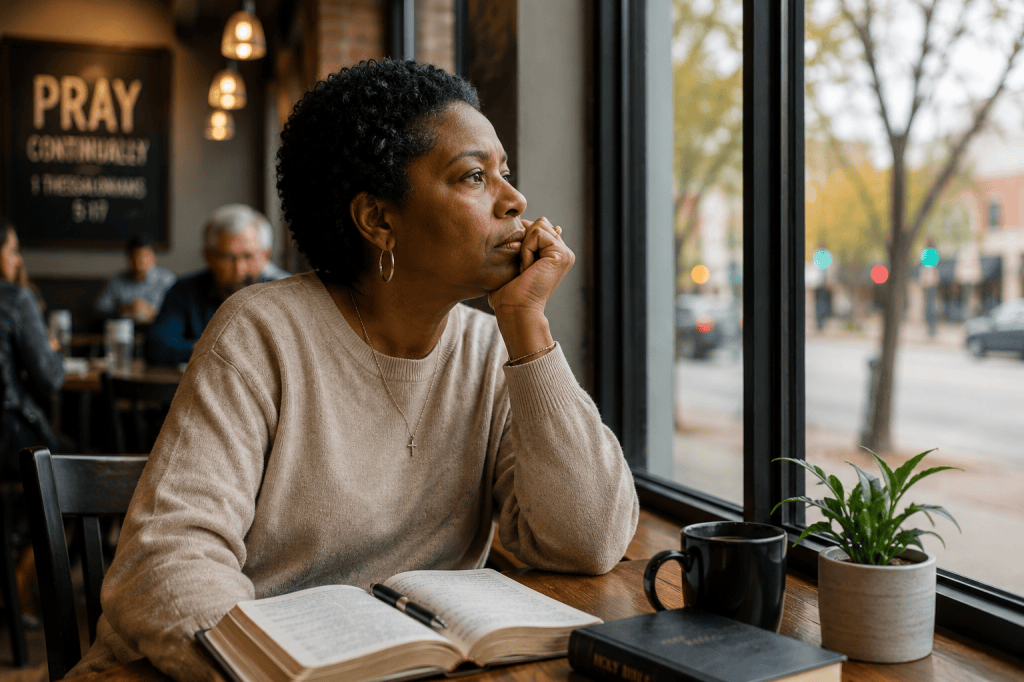
At the center of our prayer relationship lies the question: Who occupies the driver’s seat in our lives? The answer that echoes back, front, and center addresses our trust level in our God. A trust-filled way of developing a prayer relationship with our God invites us to throw open widely the doors of our heart and mind and surrender to the leadership of God in our lives, even when the mind and heart do not now get it. The humble act of building a continuous relationship with God through prayer becomes more important than when God answers.

Joy,


[1] Shakespeare, William. The Tragedy of Romeo and Juliet. Edited by Dympna Callaghan. 3rd ed. New York: W. W. Norton, 2018.

[2] Coffin, William Sloane, Jr. The Courage to Love. San Francisco: Harper & Row, 1982, 20.
Categories
Religious

Singing in the Battle

The following meditation was written by Rev. Susan Sparks, senior minister at Madison Avenue Baptist Church (American Baptist) in New York City.

Each week, I try to make it to the gym. It’s not always easy. Some days, it’s a fight just to get out the door. But I go.

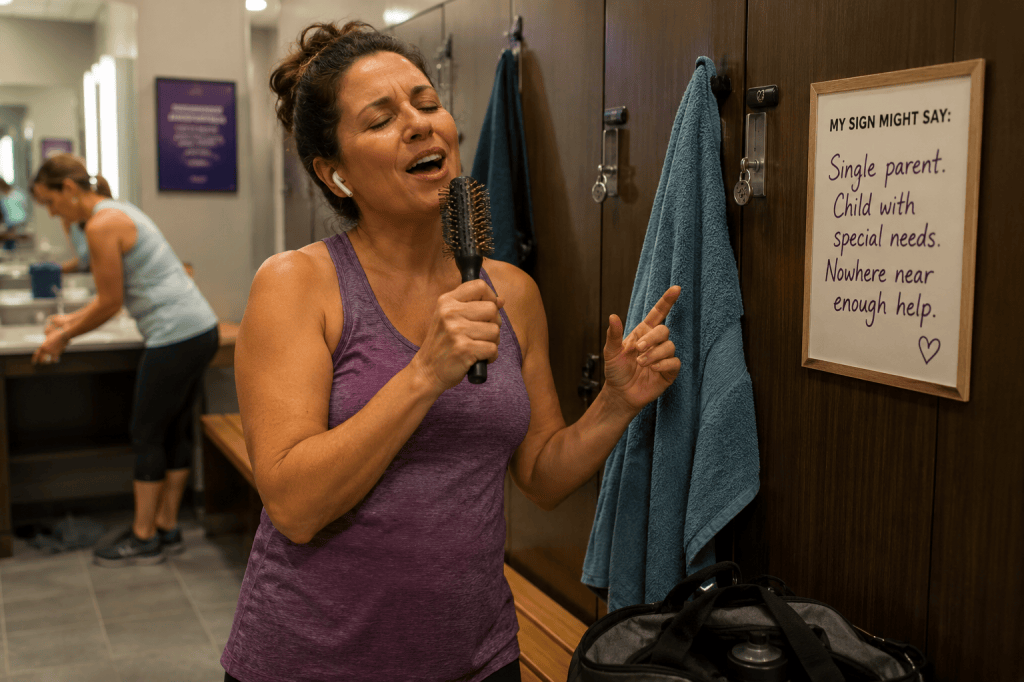
For the past year or so, there has been a woman in the locker room who sings. Sometimes humming, sometimes full-on belting out a song. It’s sweet. A little annoying, maybe. But sweet. One day last week I asked her, “What song is that you’re singing?” She smiled and said, “I have no idea. I just don’t love to work out. So, I sing myself into battle.”

Amen to that.

Every one of us is in a daily battle of some kind. Work problems. Health struggles. Family dynamics. The pressures are real. And while we know our own battles well, we rarely know what others are carrying.

The New York Times columnist Frank Bruni once wrote that if people wore sandwich boards listing their struggles, we’d move through the world with much more compassion. He shared an example of a sign a friend of his might wear: “Single parent. Child with special needs. Nowhere near enough help.”[1] What would your sign say?

We’re all fighting on multiple fronts. But we aren’t the only ones. The Bible shares story after story of people facing similar life struggles—ancient wisdom for our time. Which is why the story in 2 Chronicles 20 is such a gift. It’s a reminder that maybe we’ve been fighting all wrong.

In this three-thousand-year-old story, we find three lessons.

LESSON 1: King Jehoshaphat gets word that a vast army is headed straight for him and the people of Judah. Instead of panicking or preparing military strategy, the king does something radical: he prays. And not just a quick “Help us, God!” prayer—he prays with depth, naming God’s promises and ending with this vulnerable, faithful line: “We do not know what to do, but our eyes are on you.”[2] What if that became our mantra?

LESSON 2: Then something even more surprising happens. God’s answer to the king’s prayer doesn’t come directly to the king. God speaks from an unexpected place—a Levite in the crowd. The Levite says, “Do not be afraid. The battle is not yours, but God’s.”[3] How many battles are we fighting that were never ours to begin with? How much more peace might we find if we paused and let God take the lead?

LESSON 3: The next morning, Jehoshaphat calls out his army. But instead of soldiers, he sends singers to the front lines. That’s right—he puts the choir ahead of the infantry. As they go out to meet the enemy, they sing: “Give thanks to the Lord, for his steadfast love endures forever.”[4]

They weren’t singing because they had already won. They were singing into the battle—because they trusted in the presence of God no matter the outcome.

From Paul and Silas singing in prison to spirituals sung on freedom marches, this is a deep tradition of hope. So how do we live that today? We follow these three lessons:

We pray: “I don’t know what to do, but my eyes are on you.”

We pause: “Be still. The battle is not yours.”

We praise: Even if our voice shakes. Even if we’re scared. We lead with gratitude and sing our way into the battle.

Know whatever battle you face, you are not alone. Because faith, in the end, beats fear every time.

Joy,


[1] Bruni, Frank. The Beauty of Dusk: On Vision Lost and Found. New York: Avid Reader Press, 2022, chap. 6.

[2] 2 Chronicles 20:12.

[3] 2 Chronicles 20:15.

[4] 2 Chronicles 20:21

Categories
Religious

Ask

The following meditation was written by Kyaunnee Richardson, opera singer.

“Ask and you shall receive, seek and you shall find, knock and the door will be open to you.” Matthew 7:7, 8

Prayer has always been a staple for me growing up. My parents set the example and instilled a strong prayer life within my sister and myself. As I grew older, I began to see the importance of prayer in one’s life, from traveling mercies, big decisions, or thanking God for allowing one to see another day of life. My parents taught the whole family how to pray: we gather in a circle, hold hands, and pray over each member of our family. They made sure we were all covered under prayer. I also learned that prayer is a conversation with God, not a fancy, long-winded essay with eloquent words. Simply, “Dear God or Heavenly Father or Father in Heaven or Father God, I thank you for this day.” And he listens. As I searched the Scriptures, I found passages of how those who are committed to prayer and have a close relationship with God “moved mountains.” I wanted to test this.

In my prayer life, I wake up in the quiet early mornings of the day, pull out my journal, and begin talking with God. A lesson from a Bible study in high school brought me to Matthew 7:7,8. As I studied it, one word popped out twice: ask. It’s mentioned as the passage’s first word and mentioned again as an acronym of the whole verse. It led me to two people from the Old Testament: Joseph and, one who is often overlooked, Jabez. We all know the story of Joseph. There’s even a hit musical about him starring Donny Osman! While studying his life, I realized he never doubted God. Through his trials and suffering, Joseph’s faith in his Creator eventually brought him to have his dreams manifested, not only to better his circumstances, but to save the nation of Israel, which was part of God’s master plan. On the other hand, there’s Jabez, a man whose name meant “pain.” Yet he cried out to God and asked boldly, “O bless me, indeed and enlarge my territory, that Your hand would be with me, and that You would keep me from evil, that I may not cause pain!”[1] God answered his prayer.

I figured if God could answer the prayers of Joseph, Jabez, and my parents, he could do the same for me. I tested this and asked God to guide me in my life and singing career. I began to see him open doors for me and bring people into my life that were an absolute blessing. There were also times where I did not understand the route he was taking me. Yet my parents would always say, “What’s for you is for you.” In other words, I had to trust in God, his timing, and that he had my best interest at heart. Whatever I asked for, he heard me and the only thing I was required to do was keep going, have faith, and not doubt. I’d seek his council and keep knocking until that door opened. Simple, right? It is. My life is a testimony of prayer. As I continue to walk through this life, I see glimpses of why God brought me through certain things and the purpose he has placed upon my life—much like Joseph. And when I ask boldly for my dreams, stand firm on his promises, and they end up coming to fruition, I thank my heavenly Father for it, much like Jabez. I dare you to do the same.

Joy,


[1] 1 Chronicles 4:9-10, NKJV